Security leaders are used to losing budget arguments.
The conversation usually goes like this: you present a threat landscape, cite breach statistics, describe potential impact, and ask for investment. The CFO asks what the probability of a breach actually is. You say you can't quantify it precisely. The CFO says come back when you can. The meeting ends. The legacy stack stays.
There's a better argument. And it doesn't require you to estimate breach probability at all.
What Legacy Security Actually Costs
For a typical 250-user organization, the annual cost of maintaining a traditional security stack breaks down roughly like this:
- VPN concentrators — hardware, licensing, and maintenance
- Next-generation firewall — appliance costs and subscription fees
- Cloud gateway / secure web gateway — per-seat licensing
- VPN client licenses — per-user annual fees
- IT overhead — configuration, troubleshooting, and policy management time
Add it up, and most mid-market organizations are spending approximately $76,000 per year to maintain connectivity and perimeter security infrastructure that was designed for a world where everyone worked in an office.
That figure doesn't include the cost of downtime when VPN concentrators fail, the productivity loss from slow tunnel performance, or the engineering time spent managing firewall rules that grow more complex and brittle every year.
What Zero Trust Costs
Threatmatic's pricing model is straightforward: $10 per user per month. All-in.
No hardware to purchase. No gateway infrastructure to maintain. No per-device licensing on top of per-user fees. No separate web filtering subscription. One number.
For 250 users, that's $30,000 per year.
The Math
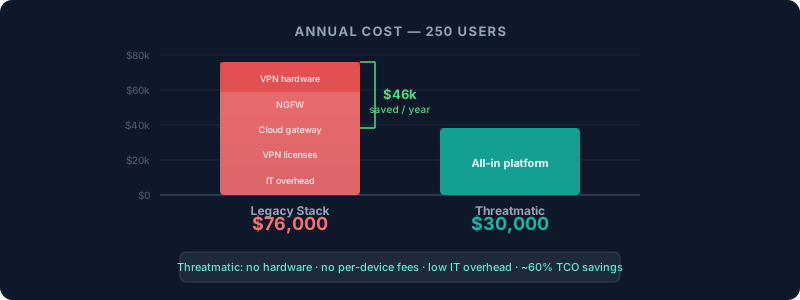
| Legacy Stack | Threatmatic | |
|---|---|---|
| Annual cost (250 users) | ~$76,000 | $30,000 |
| Hardware required | Yes | No |
| Per-device fees | Often | No |
| IT overhead | High | Low |
The difference is $46,000 per year — and that's before accounting for the operational savings from eliminating hardware refresh cycles, reducing helpdesk tickets related to VPN connectivity issues, and freeing your IT team from manual firewall rule management.
The Argument Finance Actually Hears
This is not a breach probability argument. This is not a risk tolerance conversation. This is a line-item comparison showing that your organization is spending $46,000 more per year than it needs to, for infrastructure that is less secure, less resilient, and harder to manage.
Security leaders who frame Zero Trust adoption as a cost optimization — not just a security improvement — find that the conversation with finance changes entirely. The question stops being "what's the probability of a breach?" and starts being "why are we paying $46,000 extra for something worse?"
What You Get for Less Money
Replacing your legacy stack with Threatmatic doesn't just save money. It delivers capabilities that your current infrastructure can't match:
- Identity-based access — users access specific applications, not your entire network
- Automatic microsegmentation — lateral movement is contained without manual firewall rules
- Sub-50ms threat isolation — compromised devices are contained before damage spreads
- Agent-less coverage — IoT and unmanaged devices are protected without software installation
- Continuous posture adaptation — security tightens or relaxes based on real-time context
More capability. Lower cost. Simpler operations.
The $46,000 is the starting point. The security improvement is the rest of the argument.
See how Threatmatic's all-in pricing compares to your current stack. Visit threatmatic.ai