It's 8:47 AM. A student logs into a Chromebook in Room 204. Another opens a district-issued tablet in the library. A substitute teacher connects to the staff Wi-Fi with a personal laptop. Across the building, the front office is processing attendance, a counselor is accessing student records, and the cafeteria point-of-sale system is quietly doing its job.
By the time the morning announcements finish, hundreds of devices are on your network — and your IT team, if you even have one, is already stretched thin.
This is the reality of running technology in a school. And it's exactly why traditional security tools — the ones designed for enterprise IT departments with dedicated staff and six-figure budgets — simply don't fit.
The Problem with "Enterprise Security" in Schools
Most cybersecurity platforms were built for corporations. They assume a dedicated security operations team, a predictable network of managed devices, and the time and expertise to configure complex rules, monitor dashboards, and respond to alerts.
Schools have none of that.
What schools have is a wildly dynamic environment. Students bring personal devices. Teachers share classrooms. The network population changes by the period. A device that was used for a math quiz at 9 AM might be on a completely different segment of the network by lunchtime.
Traditional firewalls and VPNs can't keep up. They enforce static rules in a world that never sits still.
A Different Approach: Security That Moves With You
Threatmatic was built for exactly this kind of environment.
Instead of requiring administrators to define every possible rule in advance, Threatmatic continuously observes, maps, and adapts to what's actually happening on the network — in real time. Every device, every user, every application is identified and assessed the moment it connects. Policies are enforced automatically, without anyone needing to intervene.
Think of it like a substitute teacher who already knows the classroom rules — and enforces them consistently, every period, every day, without burning out.
What This Looks Like in Practice
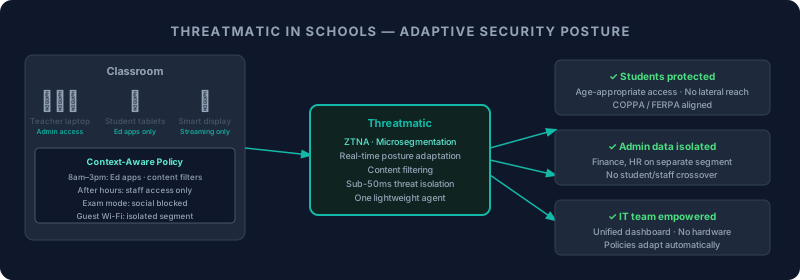
Morning arrival. As students connect their devices, Threatmatic silently maps each one — identifying whether it's a district-managed Chromebook, a personal phone, or an unknown device — and applies the appropriate access policy instantly. The student gets to their learning apps. Everything else is blocked. No one notices a thing.
During the school day. A student accidentally visits a malicious website. Threatmatic's DNS security blocks it before the page loads — no alert, no disruption to the class, no incident report required.
Staff access. A teacher connects from the staff lounge. Threatmatic recognizes their identity and device, applies staff-level access, and ensures they can reach everything they need — without exposing student records or administrative systems.
After hours. The building empties. A device left on overnight begins behaving unusually — making unexpected outbound connections. Threatmatic detects the anomaly and isolates the device automatically. By morning, it's already been flagged for review.
Simple Enough for One IT Person. Powerful Enough for Any Threat.
One of the most common things we hear from school administrators is: "We know we need better security, but we don't have the staff to manage it."
That's precisely why Threatmatic was designed the way it was. The entire platform deploys in minutes — not weeks. Security policies update in milliseconds. And because the system continuously adapts to what's happening on the network, it doesn't rely on someone being at a keyboard to catch threats.
The security posture of your school isn't a snapshot taken once a year during an audit. With Threatmatic, it's a living, breathing system that tightens or relaxes based on context — who's on the network, what they're doing, and whether anything looks wrong.
Protecting Students Is Personal
Schools hold some of the most sensitive data imaginable — student records, health information, behavioral histories, family contact details. The consequences of a breach aren't just financial. They're personal. They affect real children.
And yet the average school district has fewer cybersecurity resources than a mid-sized accounting firm.
Threatmatic exists to close that gap. Not by adding complexity, but by removing it. By making enterprise-grade Zero Trust security accessible to the people who need it most — including the administrator who is also the IT department, the counselor who just needs things to work, and the teacher who shouldn't have to think about security at all.
The Bottom Line
Cybersecurity in schools doesn't have to be complicated to be effective. The right platform adapts to your environment so your staff doesn't have to adapt to it.
When the bell rings, Threatmatic is already ready for the next period.
Interested in bringing Zero Trust to your school or district? Learn more at threatmatic.ai or reach out to start a conversation.