A badge misread at 3:47am is a maybe. Cameras don't lie, but a three-second motion spike in an empty hallway at that hour could be a shadow, a moth, a draft catching a curtain — also a maybe. A door sensor blipping open for half a second reads exactly like a glitch, because ninety-nine times out of a hundred, it is one. Every individual signal this whole series has built — the bitrate spike, the badge pattern, the BMS anomaly — is honest about what it is: a strong hint, not a verdict.
That's not a flaw. It's just incomplete, in the specific way any single witness is incomplete. And we've been treating each one like its own case, in its own dashboard, decided by its own threshold — which means each one has to clear a bar high enough to be trustworthy alone, or it gets lost as noise. Most real signals never clear that bar by themselves. They just sit there, correctly uncertain, in three different systems that have no idea the other two exist.
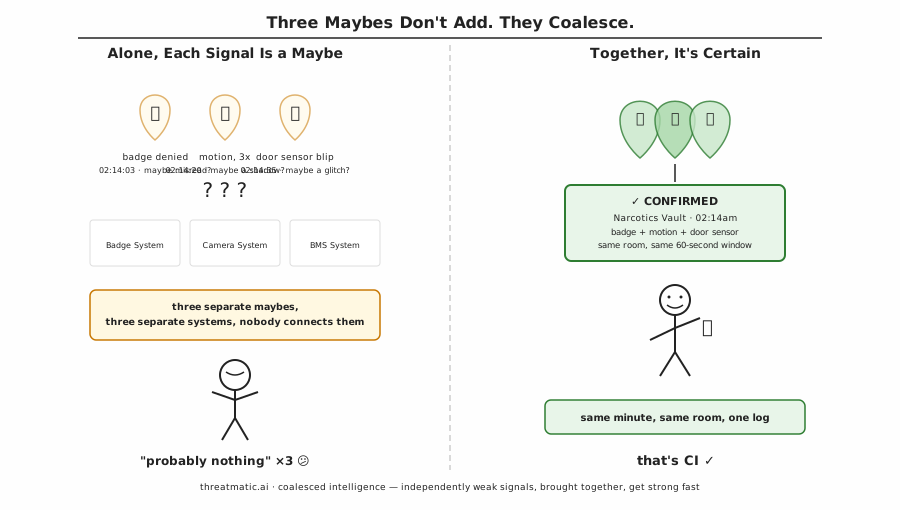
What happens when the maybes share a room
Here's the actual shift, and it isn't a smarter model. It's what happens automatically once a badge event, a camera event, and a BMS event all land in the same queryable log, timestamped, instead of three separate vendor consoles that never talk. A badge denial at the narcotics vault, alone, is a maybe. A camera motion spike in that same room, alone, is a maybe. But a badge denial and a motion spike and a door sensor anomaly, all inside the same sixty-second window, in the same room — that's not three maybes anymore. Each one raises the odds on the other two. Independently weak signals, brought together, get strong fast.
That's the part worth naming, because it isn't "AI got smarter" and it isn't "we added more sensors." It's what naturally happens the instant every device type's inference lives in one place instead of three. We're calling it Coalesced Intelligence — CI. Not a new model, a new property — the thing that shows up automatically once the parts stop being kept apart.
Why "coalesced," specifically
Two droplets touching don't stay two droplets. They merge — coalesce — into one, and the result isn't "twice the water in two places," it's a single larger drop that behaves differently than either one did alone: it holds together, falls with more weight, survives a jostle that would've scattered the originals. That's a closer physical description of what three independently-inconclusive device signals do when they land in one log than "correlation" or "fusion" ever were — those words describe stacking evidence side by side. Coalescence describes them actually becoming one thing.
There's a second reason the word fits, and it isn't just poetic: "coalescing" already means something precise in systems engineering — write coalescing, interrupt coalescing, event coalescing — the well-worn technique of merging many small, individually-cheap operations into fewer, more meaningful ones instead of handling each in isolation. That's not a metaphor borrowed from somewhere else for this post. It's the same word, doing the same job, one level up: instead of coalescing writes to a disk, this coalesces inferences across a fleet.
Still nobody's data but the org's
The instinct might be that "correlating everything" means pooling more, seeing more, holding more raw material than before. It's the opposite. Coalesced Intelligence needs less raw content than any single-device system on its own — it never touches the video, never touches the badge protocol payload, never touches the BMS telemetry stream. It only ever operates on the same clean sentences this whole series has been building toward: motion, 117x baseline. Denied, badge #4402. Door sensor, anomalous. The merging happens at the level of inference, not evidence — which is exactly why it can live inside a single org's own compute boundary, correlating across device types without ever correlating across organizations, without ever needing to see anything an operator wouldn't already be comfortable putting in a sentence.
That's the whole arc this series has been walking, one post at a time: watch the shape instead of the content, log the inference instead of the footage, make the log askable instead of searchable — and once that's true for every device on the fleet at once, the maybes start finding each other on their own.