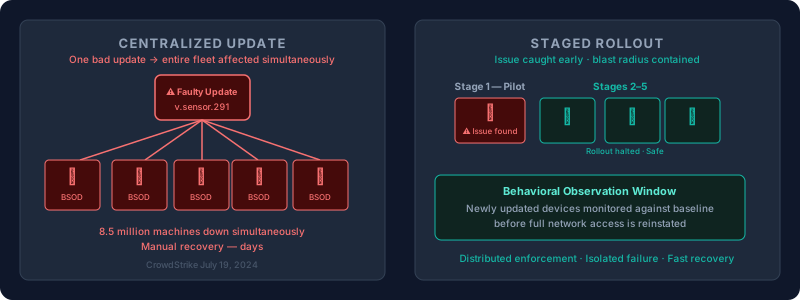
On July 19, 2024, a faulty content update to CrowdStrike's Falcon sensor triggered one of the largest IT outages in history. Approximately 8.5 million Windows machines crashed simultaneously, taking down airlines, hospitals, banks, broadcasters, and emergency services across the globe.
CrowdStrike's software did not contain malware. There was no nation-state attack. No zero-day exploit. A content configuration update — the same kind of update that is pushed silently to endpoints millions of times a day — caused a catastrophic kernel-level failure.
The incident raised a question that security vendors have been reluctant to ask about themselves: what happens when the security tool is the single point of failure?
The Centralized Agent Problem
Modern endpoint security relies on software agents running at kernel level — deep in the operating system, with broad system access and the ability to terminate processes, inspect memory, and intercept network traffic. This privileged position is what makes them effective. It is also what makes them dangerous.
When an agent at this level behaves unexpectedly — whether due to a vulnerability, a configuration error, or a faulty update — the blast radius is not limited to the security function. It can take down the entire host. And when that agent is deployed to every machine in the enterprise through an automated update pipeline, one bad update becomes an enterprise-wide crisis in minutes.
The CrowdStrike outage was not a failure of the organization's security team. Organizations had no mechanism to prevent it. The update was automatic, mandatory, and invisible — until every machine rebooted into a blue screen.
Decoupled Architecture: A Different Model
Threatmatic is architected on a different principle: security enforcement should be distributed, decoupled, and resilient to the failure of any individual component.
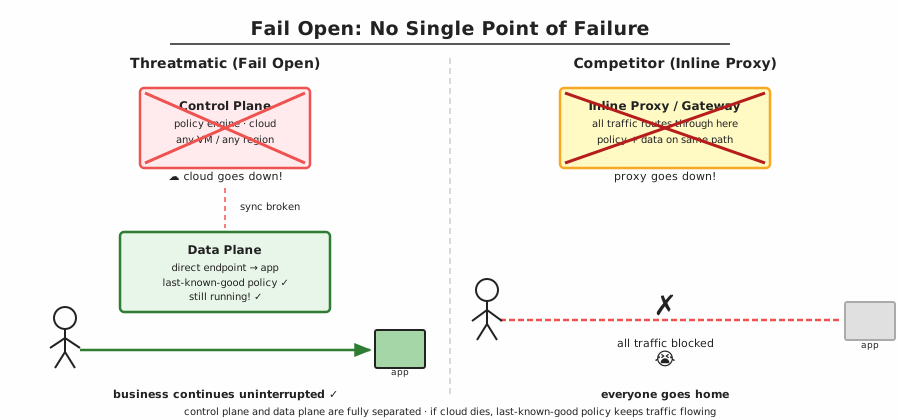
Rather than relying on a monolithic agent with kernel-level access deployed uniformly across every endpoint, Threatmatic separates the enforcement plane from the monitoring plane. Policy enforcement happens at the network layer — in the control fabric between devices — not exclusively within the device itself. This means that even in the event of an agent failure or an update anomaly, enforcement continues.
No single update, no single component, no single failure can bring down the security posture of the network.
Rogue Update Protection
The CrowdStrike incident also highlighted a threat vector that Threatmatic addresses directly: the update pipeline itself.
Software updates — even from trusted vendors — represent a potential attack surface. This has been demonstrated not only in the CrowdStrike case but in the SolarWinds supply chain attack, the Kaseya ransomware incident, and others. A compromised or faulty update can propagate to every endpoint in an organization simultaneously.
Threatmatic's bandwidth management and policy enforcement layer includes controls over software update behavior. Administrators can control which endpoints receive updates, stagger rollout windows, and isolate newly updated devices for behavioral observation before granting them full network access. The silent 14-day discovery pilot concept extends to update behavior: understand what normal looks like before enforcing it.
What Recovery Actually Looks Like
One of the most striking aspects of the CrowdStrike incident was the recovery process. Because the failure occurred at kernel level before the operating system fully loaded, automated remediation was not possible. IT teams had to physically access each affected machine, boot into safe mode, and manually delete the faulty file.
For organizations with thousands of endpoints, many of them in remote locations, that process took days.
Threatmatic's architecture keeps the recovery plane independent of the agent. Remote remediation, policy updates, and isolation decisions can be executed through the control fabric without requiring the endpoint agent to be functional. If a device is behaving abnormally — or has failed entirely — it can be isolated from the network automatically, and remediation can be pushed through an alternative channel.
The Broader Lesson
The CrowdStrike outage was not a reason to stop using endpoint security. It was a reason to stop treating any single security component as an unchecked dependency on which the entire enterprise depends.
Resilient security architecture distributes trust and enforcement. It assumes that any component can fail. It designs recovery into the system from the start.
That is what Threatmatic is built to do.
Learn how Threatmatic's distributed architecture protects against both threats and infrastructure failures. Visit threatmatic.ai