Speed without collateral damage isn't a tradeoff. It's an engineering problem.
Every DDoS defense makes a bet. Block fast and risk taking out legitimate traffic with it. Or be careful and precise, and lose the seconds that actually matter. Most vendors pick one. Threatmatic's SYN flood protection is built on the belief that you shouldn't have to.
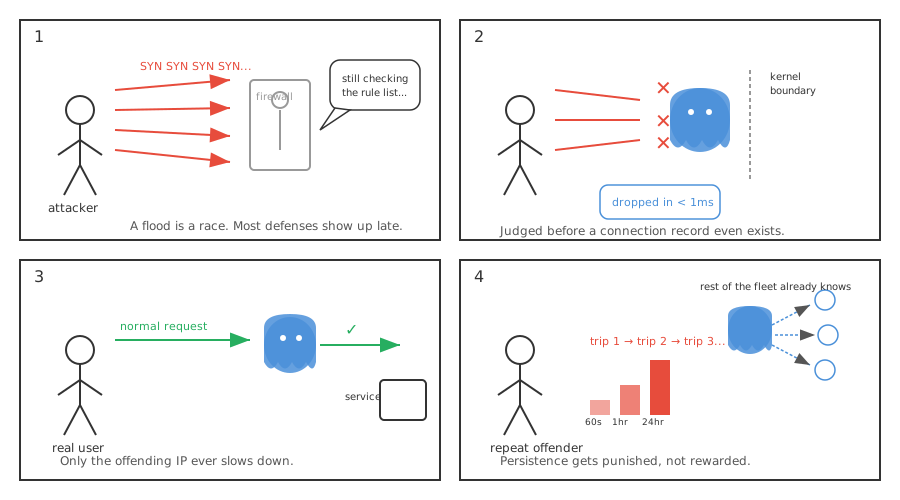
Where Most Defenses Draw the Line — And Why It's Too Late
Traditional SYN flood mitigation lives at the network edge: a firewall, a load balancer, a cloud scrubbing service. By the time traffic reaches any of those, the operating system on the target machine has already done real work — allocating a connection record, running it through the stack, waiting to see if a handshake completes. Multiply that by thousands of spoofed or compromised sources per second, and the OS itself becomes the bottleneck, regardless of how good the edge device is.
Threatmatic moves the decision to where the cost is actually paid: inside the endpoint's own network stack, before a connection record is ever created. Every inbound SYN packet is inspected and judged in the kernel datapath — accepted or dropped — before the OS commits a single byte of memory to it.
Enforcement Before the OS Even Commits Memory
The mechanism is a per-source-IP token bucket, enforced directly in-kernel:
- Each source IP earns connection "tokens" at a steady, configurable rate.
- A burst allowance absorbs normal traffic spikes without false positives.
- Once a source exhausts its tokens, its SYNs are dropped — silently, at the packet level — for a defined penalty window.
- Every other source IP keeps its own independent allowance. One attacker's flood never touches anyone else's traffic.
That last point is the part most defenses get wrong under pressure: a naive rate limiter applied globally protects the service by degrading it for everyone, attacker and customer alike. A per-source model means the only traffic that ever slows down is the traffic that earned it.
| Approach | Where it acts | Decision speed | Blast radius of a flood |
|---|---|---|---|
| Edge/cloud scrubbing | Network perimeter | Seconds to minutes (propagation) | Whole service, until rules propagate |
| Global rate limiting | Anywhere in the path | Fast | Everyone sharing the limit — attacker and customer alike |
| Threatmatic kernel enforcement | The endpoint's own kernel, pre-connection | Sub-millisecond, per packet | The offending source IP only |
Fast Isn't Enough — Fast and Precise
Speed that comes at the cost of accuracy just moves the outage from "attacker-caused" to "self-inflicted." Threatmatic's enforcement is tested specifically against that failure mode: a flood from one source, sustained well past any reasonable threshold, should never cause a dropped connection for a legitimate client sitting right next to it on the network. That isolation is a design requirement, not an afterthought — and it's what makes sub-millisecond enforcement safe to run unattended, without a human in the loop deciding whether it's safe to pull the trigger.
What's Next: Raising the Bar Further
Kernel-level, per-IP enforcement is the foundation. Here's where we're taking it.
Escalating consequences for repeat offenders. A source that trips the limiter once gets a standard timeout. A source that trips it repeatedly should face something longer — minutes, then hours, then a day — without requiring an operator to notice the pattern and intervene manually. Persistent attackers get progressively locked out; a one-time burst from a legitimate but noisy client doesn't get treated the same way twice.
Full IPv6 coverage. Plenty of DDoS tooling still treats IPv6 as an afterthought, which is exactly where attackers go looking for the gap. Threatmatic's enforcement model extends natively to IPv6 traffic — the same per-source isolation, the same in-kernel speed, no second-class protocol.
Validating before penalizing. Not every source that looks aggressive is malicious — a NAT'd office network or a legitimate burst of retries can look identical to an early-stage flood. Rather than choosing between "block and risk a false positive" or "wait and risk the flood," the next layer of defense challenges a borderline source to prove it's a real, responsive endpoint before committing to a longer block. Legitimate traffic passes the challenge and moves on unaffected; blind, spoofed floods can't.
Fleet-wide intelligence. A source flagged on one endpoint shouldn't have to be rediscovered by every other endpoint independently. As a fleet grows, each protected endpoint becomes a sensor — and the response to a known-bad source gets faster and more confident everywhere else, not just where it was first seen.
The Bottom Line
Anyone can build a fast blocklist. The hard part is building one fast enough to matter and precise enough to trust — one that never makes your own legitimate users collateral damage in someone else's attack. That's the bar Threatmatic holds itself to today, and it's the bar the roadmap above keeps raising.
See how kernel-level, per-source enforcement fits into your infrastructure. Schedule a demo or talk to our team.