The most dangerous phase of a ransomware attack isn't the moment files get encrypted. By then, it's already too late.
The real damage happens in the 48 to 72 hours before the ransom note appears — a silent window where attackers move laterally through your network, escalate privileges, identify your most valuable data, and position themselves to cause maximum harm. They're quiet, methodical, and patient. And on most corporate networks, nothing stops them.
The Flat Network Problem
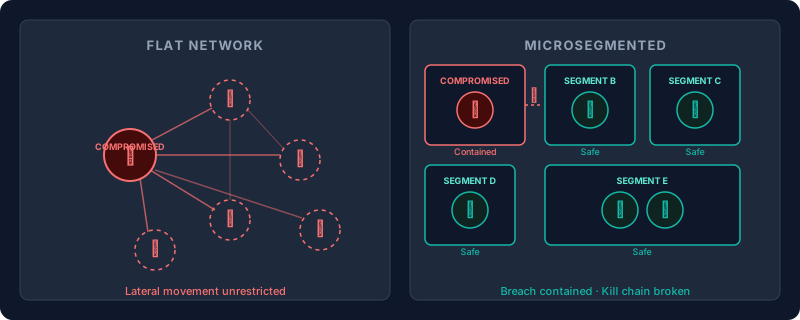
Most organizations, whether they realize it or not, operate what security professionals call a "flat network." Connected devices can reach other connected devices with little or no restriction. A workstation in accounting can talk to a server in engineering. A laptop on the guest Wi-Fi can reach internal systems. A compromised device in one office can probe every other device on the same network.
This architecture made sense when the perimeter was the boundary. When you controlled who came in through the front door, you could afford to trust everyone inside. But that model is obsolete. Attackers don't come through the front door. They come through a phishing email, a vulnerable browser plugin, a misconfigured remote desktop endpoint, or a contractor's unmanaged laptop.
Once inside, the flat network is their playground.
The ransomware kill chain depends entirely on this lateral freedom. An initial compromise on a single endpoint — one employee who clicked the wrong link — becomes a catastrophic breach because nothing prevents that compromised device from reaching everything else. Attackers discover your domain controllers. They find your backup systems. They identify your crown jewels. Then they strike everywhere at once.
The kill chain only works on flat networks.
What Microsegmentation Actually Does
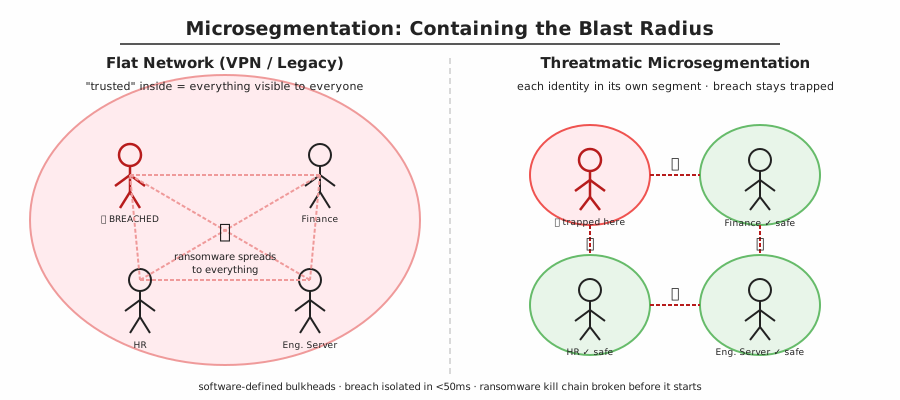
Microsegmentation is the practice of dividing your network into isolated segments where communication between segments requires explicit authorization. Instead of one large, flat space where everything can reach everything, you create a series of contained compartments — each with enforced boundaries.
The practical effect is profound. A compromised device in one segment cannot reach devices in other segments. The lateral movement that ransomware depends on is blocked at the network level, automatically, before any human has to respond.
This isn't a new concept. What has changed is the ability to implement it at scale, without an army of network engineers manually configuring firewall rules for every possible communication path.
50 Milliseconds vs. 15 Minutes
Traditional incident response to a ransomware detection event involves a human reviewing an alert, determining the affected device, remotely accessing network equipment, and reconfiguring access controls — a process that, in well-run organizations, takes 15 minutes or more. In that time, ransomware can encrypt thousands of files and propagate to dozens of additional systems.
Threatmatic's threat detection and isolation happens in under 50 milliseconds.
The moment anomalous behavior is detected — a device scanning the network, unusual outbound connections, behavioral patterns consistent with known ransomware strains — that device is automatically isolated. It can no longer communicate laterally. The spread stops. The rest of your network continues operating normally.
No human in the loop. No delay. No 15-minute window for the attack to deepen.
Active Defense: Cutting Off the Command Chain
Microsegmentation contains the spread. Active defense goes further — it cuts off the attacker's ability to control the compromised device in the first place.
Threatmatic continuously ingests threat intelligence from FBI InfraGard, CISA, and other authoritative feeds, automatically blocking outbound connections to known malicious IP addresses and domains. When a compromised device attempts to reach its command-and-control infrastructure — to receive instructions, to exfiltrate data, to download additional payloads — those connections are severed before they succeed.
An attacker with a foothold but no command-and-control channel is effectively blind. They cannot issue new instructions. They cannot receive exfiltrated data. The attack stalls.
The Bottom Line
Ransomware is a solved problem on segmented networks. The 48 to 72 hour lateral movement window that attackers depend on disappears when devices cannot freely communicate with one another. The kill chain breaks.
Threatmatic enforces microsegmentation automatically, adapts in real time, and isolates threats in under 50 milliseconds — before the ransom note ever appears.
Learn how Threatmatic's active defense stops ransomware at the source. Visit threatmatic.ai