Why the devices that run your facilities are your biggest security blind spot — and how Zero Trust changes that.
The camera above your front entrance is watching. The badge reader at the server room door is logging every swipe. The thermostat in the main office is connected to the cloud. The generator monitoring system sends alerts to a vendor three states away.
None of these devices have an IT team watching over them.
Most of them haven't been updated in years. Many were installed by contractors who are long gone, configured with default passwords that nobody ever changed. And nearly all of them are sitting on the same network as your most sensitive systems — quietly, invisibly, waiting.
This is the reality of modern facilities management. And it represents one of the most overlooked attack surfaces in cybersecurity today.
The IoT Problem Nobody Talks About
When people think about cybersecurity, they think about laptops, servers, and email phishing attacks. But the fastest-growing category of connected devices isn't computers — it's everything else.
Security cameras. Door access controllers. HVAC and building automation systems. Environmental sensors. Smart lighting. Power monitoring equipment. Elevator controls. Fire suppression systems.
These devices are increasingly networked, increasingly sophisticated, and almost universally unmanaged from a security standpoint. They run stripped-down operating systems that can't support traditional security agents. They're often configured once and forgotten. And because they're "just infrastructure," they rarely appear on anyone's security radar — until something goes wrong.
The consequences when they do go wrong can be severe. A compromised camera system exposes physical security footage. A breached building access controller can unlock doors remotely. An attacker who gains a foothold through an HVAC system — as happened in one of the most famous retail breaches in history — can pivot from there to financial systems, personnel records, or operational controls.
The Challenge: You Can't Put an Agent on a Camera
Traditional cybersecurity approaches hit a fundamental wall with IoT devices: you can't install software on them.
A security camera doesn't run Windows. A badge reader doesn't have a browser. An environmental sensor doesn't have a user interface. These devices speak their own protocols, run their own firmware, and were never designed to participate in a security ecosystem.
This leaves most organizations with an uncomfortable choice: either leave these devices completely unprotected, or spend enormous effort trying to isolate them manually through complex VLAN configurations and firewall rules that quickly become impossible to maintain as the environment grows.
Neither option is acceptable. And neither has to be.
Zero Trust for the Physical World
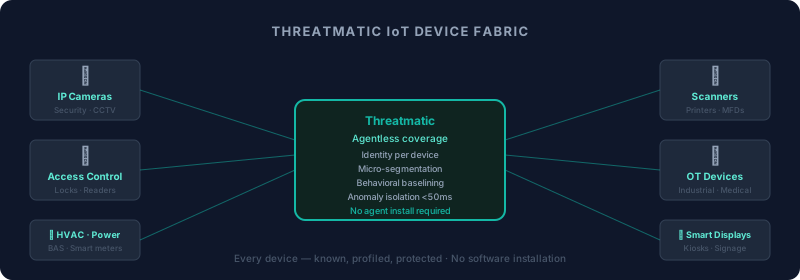
Threatmatic was built to protect networks — not just the devices on them. That distinction matters enormously for IoT.
Through agent-less enrollment, Threatmatic can discover, identify, and enforce policy on any device connected to your network — including cameras, scanners, access controllers, and building management systems — without installing anything on the device itself. The moment a device connects, Threatmatic maps its identity, its communication patterns, and its expected behavior. From that baseline, it continuously monitors for anything unusual.
A camera that suddenly starts making outbound connections to an unfamiliar IP address in a foreign country? Flagged and isolated automatically — before any data leaves.
A building access controller that begins scanning other devices on the network? Contained in milliseconds, with an alert generated for review.
An HVAC system that starts communicating on ports it has never used before? Quarantined while the anomaly is investigated — with zero disruption to the rest of the network.
Microsegmentation Without the Complexity
One of the most powerful protections against IoT-based attacks is microsegmentation — the practice of isolating devices so that even if one is compromised, it cannot reach anything else on the network.
Done manually, microsegmentation is an IT nightmare. It requires detailed knowledge of every device, every communication flow, and every dependency — and it has to be maintained as the environment changes.
With Threatmatic, microsegmentation is automatic. Devices are grouped by type, function, and behavior. Cameras talk to camera management systems — and nothing else. Access controllers communicate with their management consoles — and nothing else. Building automation systems operate in their own isolated segment, separated from HR systems, financial databases, and everything that an attacker would actually want to reach.
The network becomes a series of contained compartments. A breach in one compartment stays in that compartment.
Continuous Adaptation for a Changing Environment
Facilities are never static. New devices get added. Old ones are replaced. Vendors connect remotely for maintenance. Contractors bring their own equipment on-site.
Every change is a potential security event — and in most organizations, it goes completely unnoticed.
Threatmatic continuously maps the network as it evolves. New devices are discovered and assessed the moment they connect. Unknown devices are flagged for review. Vendor access is monitored and time-limited. The security posture of your facility adapts in real time, without requiring anyone to manually update a spreadsheet or reconfigure a firewall.
The Stakes Are Higher Than You Think
A cyberattack on your IT systems is serious. A cyberattack on your physical infrastructure is something else entirely.
Loss of camera visibility during a security incident. Building access controls that no longer respond. HVAC systems manipulated to trigger false alarms or create unsafe conditions. Power monitoring systems taken offline during a critical period. These aren't hypothetical scenarios — they are documented attack vectors that adversaries are actively exploring.
The organizations that will weather these threats are the ones that take their physical network as seriously as their digital one.
One Platform. Every Device.
Threatmatic doesn't distinguish between a laptop and a camera, between a server and a smart thermostat. Every device on your network is a potential risk and a potential target — and every device deserves to be protected.
With agent-based protection for managed endpoints and agent-less coverage for everything else, Threatmatic gives you complete visibility and control across your entire environment — without the complexity, without the headcount, and without leaving your infrastructure exposed.
Your building is already online. Make sure it's secure.
Want to see how Threatmatic protects IoT and OT environments? Visit threatmatic.ai or get in touch to discuss your facility's specific needs.