Open any inbox on any given afternoon and you'll find the same thing: a car insurance quote, a recipe newsletter, a political fundraising blast, three retail sales, a bank notification, a package delivery update. Dozens of messages, all competing for a fraction of a second of attention before the next one arrives.
Somewhere in that pile, on an ordinary Tuesday, sits the one that isn't noise.
The Ones That Don't Belong
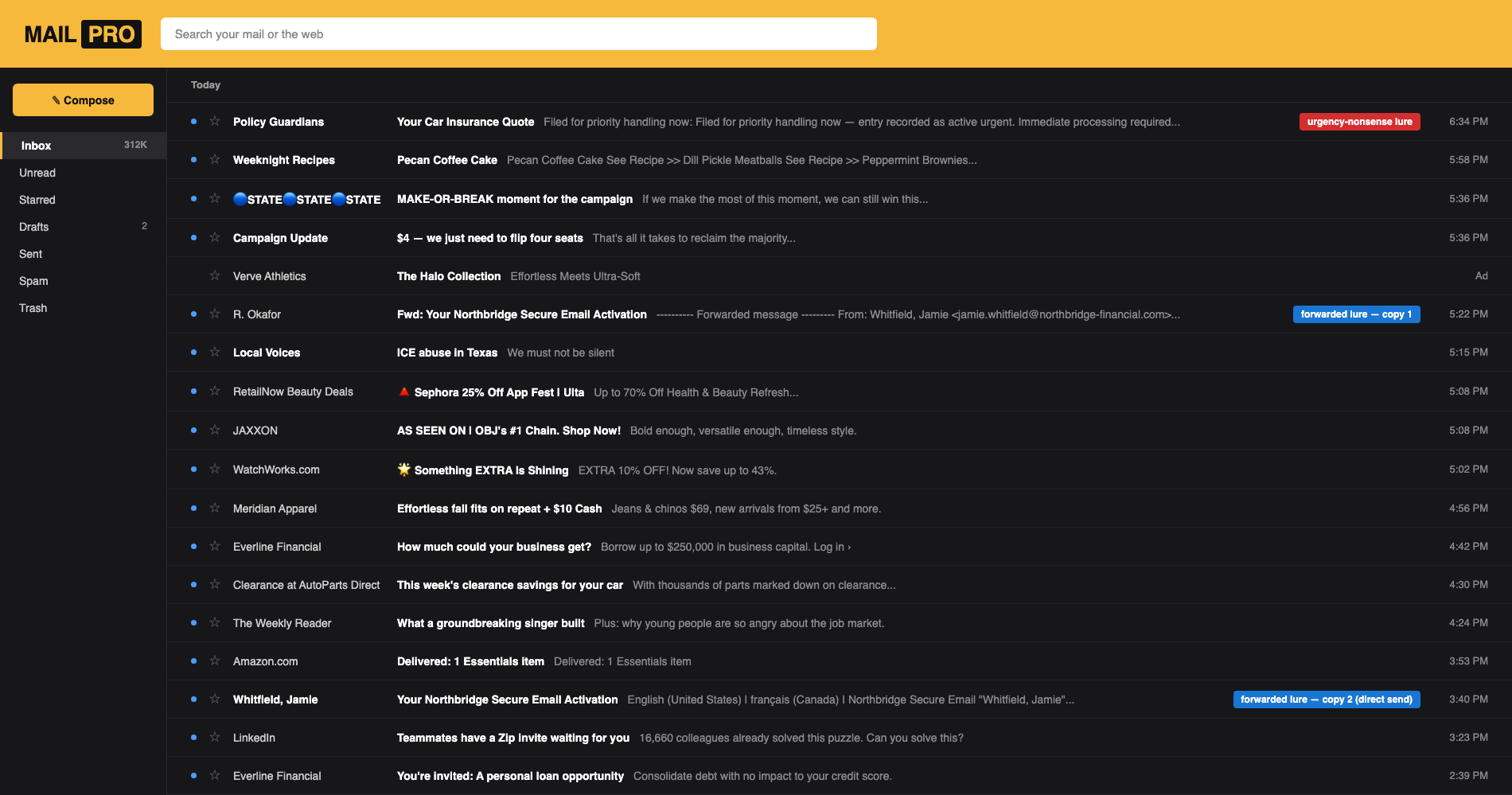
(Recreated for illustration — sender names, the bank, and the forwarding contact above are fictional. The two patterns annotated in red and blue are real.)
Scrolling through a real inbox recently, two messages stood out — not because they looked dangerous, but because they didn't look like anything at all. That's the point.
The first: a car insurance quote from a sender with no real brand behind it, previewed with a line that reads like it was assembled to sound official rather than to mean anything — "Filed for priority handling now: Filed for priority handling now — entry recorded as active urgent. Immediate processing required to sustain operational flow..." Read it twice and it says nothing. That's by design. Bureaucratic-sounding filler, repeated for emphasis, manufactures urgency without giving a reader anything concrete enough to question. It's built to be skimmed, not read — and skimmed is exactly when it works.
The second was quieter, and more effective for it: a "secure email activation" notice, supposedly from a bank. It showed up twice — once sent directly, and once forwarded from a contact's account. Same lure, two different paths into the inbox. A cold send from an unknown sender is easy to be suspicious of. A forward from someone you know arrives with their trust already attached to it. That's the entire mechanism: the second copy doesn't need to convince you of anything the first one couldn't — it just needs to borrow credibility the first one didn't have.
Neither of these needed to be sophisticated. They needed to be plausible for about two seconds — long enough for a click.
Why One Click Is Enough
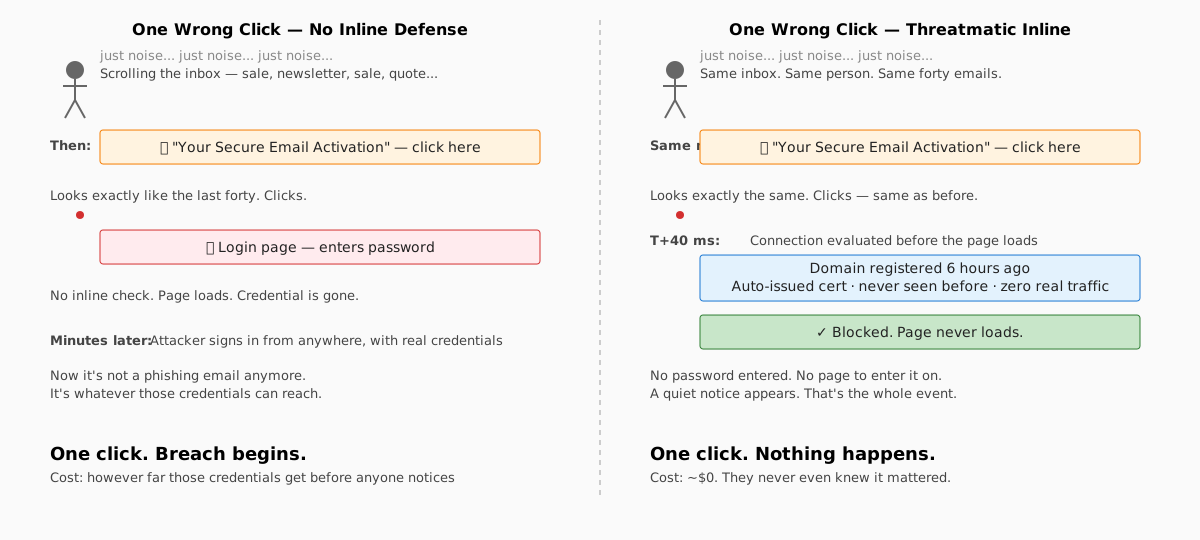
A phishing email doesn't have to defeat a spam filter, a firewall, and a security team. It has to defeat one person, one time, and everything after that follows automatically. Click the link, land on a page built to look like the real login screen, enter a password — the credential is gone before anyone realizes the page wasn't real.
From there, it isn't really about the email anymore. It's about what those credentials can reach.
The Inbox Isn't the Last Line of Defense
Security awareness training helps people spot more of these. It will never help them spot all of them — the good ones aren't designed to be spotted, they're designed to blend into a hundred other messages that are genuinely harmless. Expecting a person to bat a thousand, every day, forever, isn't a security strategy. It's a hope.
The alternative isn't a smarter inbox. It's a network that doesn't take the destination's word for it. A domain that only exists to catch one wave of clicks looks different from one that's operated a real business for years — differently aged, differently certified, differently trafficked — and those differences are visible at the connection level before a single credential is ever typed in. Whether the click happens or not, the destination gets evaluated on its own.
That's the actual fix: not making the click impossible, but making it survivable. Here's how the signal evaluation behind that works — and why it doesn't rely on anyone reading the fine print of an email that was built not to be read at all.
Threatmatic evaluates every outbound connection inline, so one wrong click stays exactly that — one click, not a breach. Visit threatmatic.ai