Inspection that learns. Coverage that scales. Deployment that anyone can do
Rules are a starting point. They are not a destination.
Every rule in a threat intelligence blocklist was written by a human who had already seen the threat. The adversary already won that round. By the time /ca is on a C2 beacon list, hundreds of networks have already reported traffic to it. The rule is the autopsy, not the prevention.
This is the fundamental limit of rule-based inspection. It is not a criticism of the people who write the rules — those lists are valuable, maintained with discipline, and catch real threats every day. It is a structural observation: rules describe the past. Threats live in the future.
Threatmatic π was built to close that gap.
What the Data Looks Like
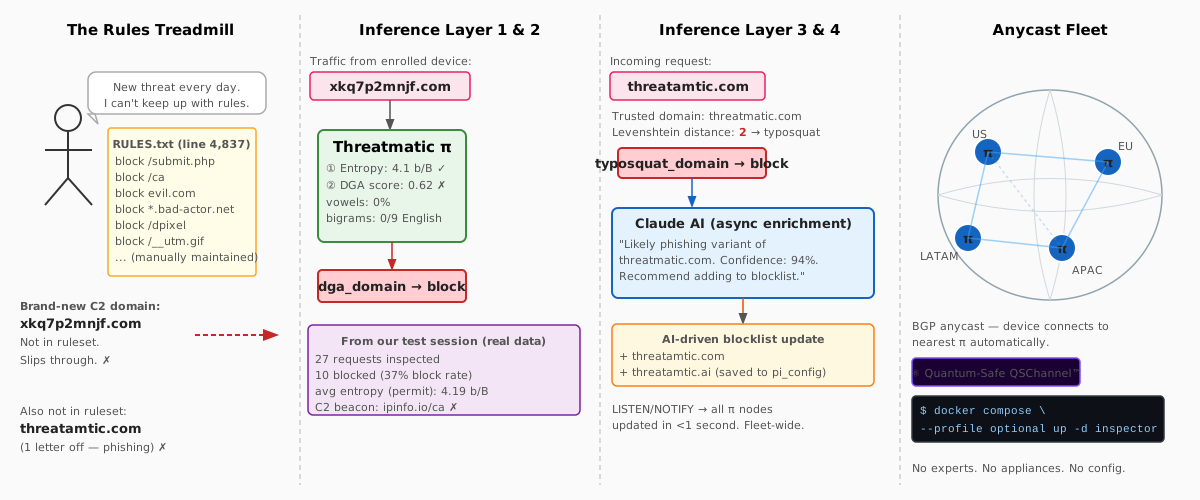
Before getting to the architecture, a grounding note. The numbers below are real — pulled from a single test session running Threatmatic π on a developer's workstation, inspecting normal browsing traffic over a few hours.
Total requests inspected:   27
Blocked:                    10  (37%)
Permitted:                  17  (63%)

Classification breakdown:
  normal           17   permit   avg entropy: 4.19 b/B
  blocked_domain    7   block    (domain blocklist — config-driven)
  c2_beacon         3   block    (path pattern match)

Hosts seen:
  threatmatic.ai       normal    3.32 b/B   — plain HTML
  docs.threatmatic.ai  normal    5.51 b/B   — slightly richer content
  ipinfo.io            normal    4.94 b/B   — JSON API response
  ipinfo.io/ca         c2_beacon blocked    — C2 beacon path on legitimate domain
  example.com/ca       c2_beacon blocked    — same pattern, different domain
  threatmatic.com      blocked_domain       — org-configured domain block
The most interesting line is ipinfo.io/ca. ipinfo.io is a perfectly legitimate IP geolocation API — used by thousands of applications daily, no malicious associations. But append /ca to the path, and you have a C2 beacon pattern that matches a known command-and-control staging technique: use a reputable domain as cover, encode the beacon channel in the URL path.
The domain is innocent. The path is not. That distinction is only visible at layer 7.
Inference Layer 1: Shannon Entropy
The foundation of Threatmatic π's inference is Shannon entropy — a measure of byte-level randomness in a payload, scored on a 0–8 scale (bits per byte).
Plain text scores low. A typical HTML response lands around 3.5–4.5. JSON hovers near 4.0–5.0. The threatmatic.ai homepage in our session scored 3.32. The ipinfo.io JSON response scored 4.94.
Encrypted or compressed payloads score high. A TLS-encrypted blob forced through a second layer of encryption — the signature of data exfiltration or a C2 channel — typically scores above 6.5. Entropy above 7.5 is nearly always ciphertext or a packed binary.
Threatmatic π applies separate thresholds by traffic direction:
| Direction | Method | Default threshold | Rationale |
|---|---|---|---|
| Outbound | POST / PUT body | 6.0 | Low tolerance — exfiltration disguised as an upload |
| Inbound | GET response | 7.0 | Higher — gzip/brotli compressed assets score ~6.5–6.8 |
The split matters. A single threshold at 6.0 would block legitimate CDN responses — gzipped JavaScript, brotli-compressed images. Splitting by direction lets the inspector be aggressive on outbound data without generating noise on normal inbound content.
Entropy alone does not make a brain. It is a signal, not a verdict. The inference layers above it are where the learning happens.
Inference Layer 2: DGA Detection
Domain Generation Algorithms are how modern botnets survive takedowns. Instead of hardcoding a C2 domain that can be seized, the malware and the server both run the same algorithm to generate a daily list of thousands of candidate domains — one or two of which the attacker registers on any given day. The botnet finds its server. The defender has no static rule to write.
Threatmatic π detects DGA domains using four statistical signals applied to the second-level domain label:
Label length — algorithmic labels are typically long. Natural brand names rarely exceed 12 characters. xkq7p2mnjf is 10; a3f9kzmqwpvl is 12.
Character entropy — random character selection produces near-maximum entropy. Human-chosen names have far lower entropy — they are words, or abbreviations of words, or combinations that sound pronounceable.
Vowel ratio — English words average ~38% vowels. DGA outputs drawn from the full alphabet average ~19%. A label like xkq7p2mnjf has zero vowels.
Bigram coverage — consecutive character pairs in natural language follow predictable frequency patterns. th, he, in, er, re are common. DGA labels produce bigrams that match English patterns at near-zero rates.
No single signal triggers a classification. Scores are additive — a label must accumulate suspicion across multiple dimensions before it is classified as dga_domain. This is what keeps amazonaws, cloudflare, and threatmatic — all legitimate, all statistically unremarkable — well below the threshold.
The result against our test domains:
xkq7p2mnjf.com       score: 0.62   → dga_domain (block)
a3f9kzmqwpvl.net     score: 0.72   → dga_domain (block)
threatmatic.com      score: 0.00   → safe
cloudflare.com       score: 0.00   → safe
amazonaws.com        score: 0.12   → safe
Zero external API calls. Zero new dependencies. Sub-millisecond per request.
Inference Layer 3: Typosquat Recognition
A DGA domain looks random. A typosquat domain looks almost right.
threatamtic.com. gooogle.com. micosoft.com. These are not algorithmically generated — they are crafted by humans who know exactly which domains their targets trust. They register a domain one keystroke away from a legitimate brand, issue a TLS certificate, and wait for someone to make a mistake.
Standard rules cannot catch them, because the variations are infinite. You cannot write a rule for every possible transposition of every domain you trust.
Threatmatic π detects typosquats using Levenshtein edit distance — the minimum number of single-character insertions, deletions, or substitutions required to transform one string into another. It computes this distance between the incoming second-level domain and every domain in the organization's trusted allowlist.
A domain 1–2 edits away from a trusted domain, but not identical to it, is flagged as typosquat_domain.
The threshold scales with label length:
- Labels under 6 characters are skipped entirely — too short for reliable scoring
- Labels 6–9 characters: maximum distance 1
- Labels 10+ characters: maximum distance 2
The protected list requires no extra configuration. It is derived directly from the organization's allowed_domains in the inspector config — the same list that grants trusted domains exemption from all other checks. Add threatmatic.com to your allowlist, and every variation of it is automatically protected.
The punycode normalization pass catches homograph attacks: Cyrillic а substituted for Latin a arrives as xn-- encoded in the DNS layer and is decoded before distance scoring.
threatamtic.com  vs  threatmatic.com  →  distance 2  →  typosquat_domain (block)
threetmatic.com  vs  threatmatic.com  →  distance 2  →  typosquat_domain (block)
gooogle.com      vs  google.com       →  distance 1  →  typosquat_domain (block)
google.com       vs  google.com       →  distance 0  →  exact match, permitted
Inference Layer 4: AI Enrichment and Autonomous Blocklist Evolution
The first three layers work in real time, inline, with no external calls. The fourth layer works differently — it operates asynchronously, over events that have already been logged, and it closes the feedback loop.
Async enrichment — flagged events (anything classified as blocked_domain, c2_beacon, dga_domain, typosquat_domain, or data_exfil) are queued for analysis by Claude. The model receives the host, path, method, content-type, entropy score, and a sample of the payload. It returns a threat reasoning statement and a confidence score, stored as ai_classification and ai_confidence on the event record. The Metrics → π Inspection console surfaces this reasoning inline — an operator investigating an alert sees not just what was blocked, but why, in plain language.
Autonomous blocklist suggestions — a periodic background job reviews recent blocked events and asks Claude: "Based on this traffic pattern, should any new domains or paths be added to this organization's blocklist?" The model returns structured recommendations that either auto-apply to pi_config or surface in the console as one-click approvals. The operator remains in control. The model does the pattern recognition.
This is the loop that rules alone cannot close. Every blocked event becomes a training signal. Every cluster of suspicious-but-novel behavior becomes a candidate rule. The blocklist evolves — not because an analyst spent an hour writing regex, but because the system observed traffic, reasoned about it, and proposed a response.
Global Coverage: The Anycast Fleet
A single inspection node covers a single network segment. A fleet covers everything.
Threatmatic π is designed to deploy as an anycast fleet: every inspection node in the fleet advertises the same IP address via BGP. Traffic from an enrolled device is automatically routed to the nearest node — not by DNS round-robin, not by an application-layer load balancer, but by the routing layer itself. Frankfurt endpoints inspect in Frankfurt. Singapore endpoints inspect in Singapore. Failover is instantaneous and automatic — if a node fails, BGP reconverges and traffic routes to the next nearest node without any configuration change.
This architecture has an important property for certificate management. All nodes in the anycast group share a single CA certificate — generated once, stored securely, distributed to each node at startup. Enrolled devices trust one certificate. That trust is valid across the entire fleet. There is no per-node certificate distribution problem.
Configuration changes propagate to every node in the fleet simultaneously. When an operator updates a threshold or adds a domain to the blocklist in the Threatmatic console, the server action fires a PostgreSQL NOTIFY on the pi_config_changed channel. Every inspection node maintains a persistent LISTEN connection to the database. All of them wake simultaneously, fetch the updated configuration, and begin enforcing the new rules — in under one second, fleet-wide.
This is what elastic inspection capacity looks like in practice. Adding a node expands coverage instantly. Removing one contracts it. The fleet scales without coordination overhead, without reconfiguration, without a change control window.
Quantum-Safe by Design
The QSChannel mesh that carries traffic to and between inspection nodes uses post-quantum cryptography throughout. Key exchange is performed using algorithms resistant to attacks from quantum computers — including Harvest Now, Decrypt Later adversaries who are collecting today's encrypted traffic for future decryption.
This is not a future capability. It is the default. Every device enrolled in the QSChannel mesh, every tunnel established between a device and an inspection node, every connection between inspection nodes — all use quantum-safe primitives from day one.
The implication for payload inspection is direct: the traffic that Threatmatic π inspects cannot be retroactively decrypted by a sufficiently powerful future adversary. The inspection happens in real time, at the point of transit. The telemetry is stored as structured metadata — host, path, method, classification, entropy score — not as captured ciphertext. There is nothing to harvest.
Ultra-Simple Deployment: No Experts Required
The operational story for Threatmatic π is a single step — provision an inspection node and it joins the fleet. No appliance procurement. No rack space. No network re-architecture. No separate management console to learn. No expert services engagement.
The prerequisites are equally simple. Enrolled devices already participate in the QSChannel™ mesh — the quantum-safe overlay network that routes their traffic. A single QSChannel™ peer configuration change routes all traffic transparently through the nearest inspector. The CA certificate is distributed to enrolled devices through the same agent onboarding flow that provisions the QSChannel™ keys — it arrives automatically, trusted at the system level, requiring no action from the device owner.
From an operator's perspective, deploying payload inspection to an entire fleet means:
- Provision an inspection node
- Set the organization and mode in the Threatmatic console
- Configure thresholds and domain lists in the Threatmatic console
- Review the π Inspection page and watch events appear
That's it. The QSChannel™ mesh handles traffic direction. The agent handles certificate trust. The inspector handles classification, enforcement, and telemetry. The console handles visibility and configuration.
Security that requires a specialist to deploy gets deployed by specialists — which means it covers the organizations that can afford specialists. Security that anyone can deploy covers everyone.
The Classification Stack
For reference, the full precedence order that every request traverses in under a millisecond:
| Priority | Classification | Trigger | Action |
|---|---|---|---|
| 1 | normal | Host in org allowlist | permit immediately |
| 2 | blocked_domain | Org-configured domain blocklist | block |
| 3 | blocked_path | Org-configured path fragment | block |
| 4 | c2_beacon | Known C2 URL pattern | block |
| 5 | dga_domain | Statistical DGA score ≥ 0.55 | block |
| 6 | typosquat_domain | Edit distance ≤ 2 from trusted domain | block |
| 7 | suspicious_method | CONNECT/DELETE /admin etc. | block |
| 8 | data_exfil | Entropy ≥ threshold by direction | block |
| 9 | normal | Everything else | permit |
Rules are the starting point. Inference is the destination.
Threatmatic π™ is available to enterprise customers. Anycast fleet deployment, quantum-safe QSChannel, and AI enrichment are available in the current release. Contact us to discuss deployment options for your fleet.