Quantum computers capable of breaking modern encryption don't exist yet. But the attack has already begun.
Understanding why requires understanding a strategy that nation-state adversaries have been executing quietly for years — one that makes the timeline of quantum computing far less relevant than most security leaders assume.
Harvest Now, Decrypt Later
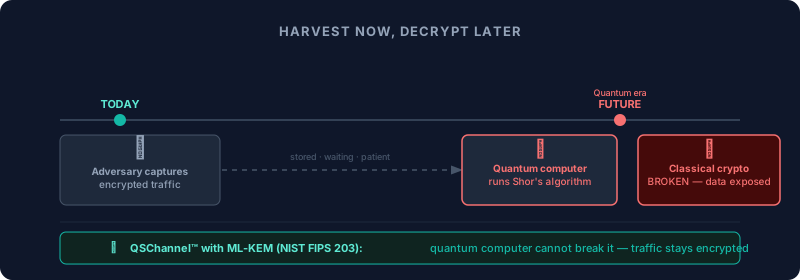
The strategy is called "harvest now, decrypt later" — and it's exactly what it sounds like.
Adversaries are intercepting and storing encrypted network traffic today. Your VPN tunnels. Your TLS-encrypted API calls. Your secure file transfers. All of it is being captured and archived, waiting for the day when sufficiently powerful quantum computers can break the encryption that currently protects it.
That day may be five years away. It may be ten. But the data being collected today will still be sensitive then. Personnel records. Intellectual property. Financial data. Strategic communications. Medical histories. The shelf life of sensitive information vastly exceeds the timeline of quantum computing development.
This means the threat is not theoretical. It is active. The question is not whether your current encrypted traffic will eventually be readable — it's whether you've already switched to encryption that can't be broken by quantum methods.
Why Standard Encryption Falls Short
Most network encryption relies on mathematical problems that are extremely hard for classical computers to solve — the factoring of large numbers, or the discrete logarithm problem. These form the basis of RSA, ECDH, and the key exchange mechanisms underlying TLS and most VPN protocols.
Quantum computers, using an algorithm developed by mathematician Peter Shor in 1994, can solve these problems efficiently. What would take a classical computer millions of years can be accomplished by a sufficiently powerful quantum machine in hours or days.
NIST recognized this threat and spent years evaluating post-quantum cryptographic algorithms — ones designed to resist attacks from both classical and quantum computers. In 2024, NIST finalized its first set of post-quantum cryptography standards, including FIPS 203 (ML-KEM, for key encapsulation), FIPS 204 (ML-DSA, for digital signatures), and FIPS 205 (SLH-DSA, for stateless hash-based signatures).
Government agencies are already required to begin transitioning. Regulated industries are next.
What QSChannel™ Does Differently
QSChannel™ was built from the ground up with post-quantum cryptography as a native requirement — not an add-on.
At the core of QSChannel™ is asymmetric path isolation: outbound and inbound traffic travel on completely separate encrypted tunnels, each with independent encryption keys. This architectural choice has two critical implications.
First, it means that compromising one direction of a communication session yields no information about the other. Session hijacking — already difficult — becomes mathematically impossible.
Second, and more relevant to the quantum threat, it means that QSChannel™ can implement quantum-resistant key encapsulation on both paths independently, using ML-KEM (the NIST FIPS 203 standard), ensuring that harvested traffic from today cannot be decrypted by quantum computers in the future.
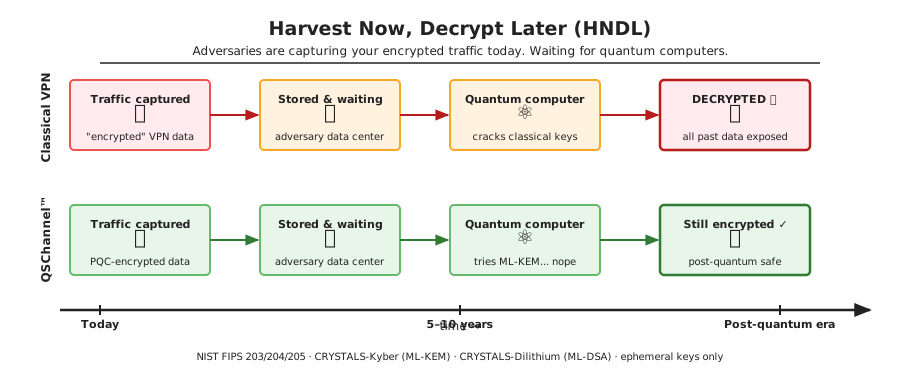
Every session generates a fresh key pair. No long-lived keys are ever reused. A compromised device yields zero usable cryptographic material from prior sessions — a property known as Perfect Forward Secrecy, which QSChannel™ treats as a baseline requirement, not an optional feature.
The Compliance Dimension
For organizations in regulated industries, the quantum transition is becoming a compliance requirement, not just a security recommendation.
NIST's standards are being adopted by CISA, the NSA, and other regulatory bodies as mandatory migration targets. Cyber insurers are beginning to factor quantum-safe encryption into underwriting decisions — organizations that can demonstrate PQC adoption are increasingly viewed as lower-risk, with direct implications for premium pricing and coverage terms.
For government contractors, defense suppliers, healthcare organizations, and financial institutions, the question is no longer "should we adopt post-quantum cryptography?" but "how quickly can we transition?"
The Window Is Closing
The common mistake is treating quantum computing as a future problem. Harvest now, decrypt later means the threat is present-tense. Every day that sensitive data travels over classically-encrypted networks is another day of exposure to adversaries who are patient enough to wait.
QSChannel™ closes that window — protecting what you transmit today against the decryption methods of tomorrow.
Learn how QSChannel™ implements NIST-compliant post-quantum cryptography. Visit threatmatic.ai