The signature-based model of cybersecurity made sense in an era when threats were relatively finite and known. A new piece of malware would appear, researchers would analyze it, extract identifying characteristics, and distribute those signatures to detection tools worldwide. Organizations running up-to-date signature databases would be protected against yesterday's threats.
The problem is that today's threats are not yesterday's threats.
Modern adversaries — particularly nation-state actors and sophisticated criminal organizations — operate on a different tempo. They test against leading security tools before deployment. They modify payloads to evade known signatures. They use legitimate software as cover for malicious behavior. They operate through trusted channels, from trusted IP addresses, using techniques that generate no signatures to detect.
Against this threat landscape, signatures are necessary but not sufficient. What's needed is signals intelligence.
What Signals Intelligence Means in Practice
Signals intelligence, in a cybersecurity context, is the practice of extracting meaning from patterns of behavior rather than from the content of individual events.
A single unusual DNS query may mean nothing. A device making 300 DNS queries in 60 seconds to domains registered in the past 48 hours — that is a signal. A user logging in from a new location is unremarkable. A user logging in from a new location at 3 AM, accessing resources they have never touched before, and downloading at 10x their historical rate — that is a signal.
Individually, any of these events has an innocent explanation. In combination, they describe a behavioral pattern that warrants investigation. Signals intelligence is the discipline of correlating these patterns at scale, across the full fabric of network activity, to surface threats that no individual event would reveal.
The Detect-Anywhere, Protect-Everywhere Model
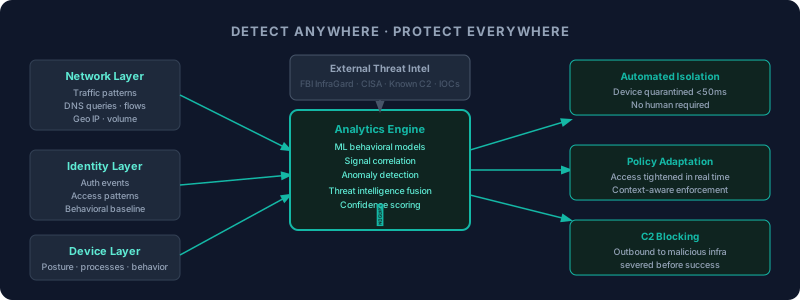
Traditional security architecture creates detection silos. The firewall sees network traffic. The endpoint agent sees process behavior. The SIEM correlates logs after the fact. Each tool has visibility into its domain. None has visibility into the whole.
Threatmatic's architecture is built on a different model: a unified telemetry fabric that spans the network layer, the identity layer, and the device layer simultaneously. Every connection, every authentication, every policy decision generates a signal. Those signals flow into a continuous analytics pipeline that maintains behavioral baselines for every user, device, and application in the environment.
When behavior deviates from baseline — anywhere in the fabric — the response is immediate and automatic. Detection and enforcement are not separated by a human review cycle. The detect-anywhere, protect-everywhere model means that a signal observed at the network layer can trigger enforcement at the device layer before a human analyst has read the first alert.
Machine Learning That Adapts to Your Environment
Generic threat intelligence is valuable. But no two organizations have identical behavioral patterns. The baseline for a financial institution with 24/7 trading operations is completely different from the baseline for a manufacturing company with shift-based schedules. Generic ML models trained on aggregate data will generate false positives in both environments — and false positives are the enemy of operational security, because they train security teams to ignore alerts.
Threatmatic's analytics layer maintains organization-specific behavioral models. The baseline for your environment is learned from your environment — your users, your devices, your applications, your traffic patterns. Anomaly detection is calibrated to what is actually unusual for your organization, not what is unusual in aggregate across millions of other organizations.
The result is higher-fidelity signals with lower false positive rates — and a security team that responds to alerts rather than filtering them out.
Integrating External Threat Intelligence
Signals intelligence from within the organization is most powerful when correlated with authoritative external intelligence.
Threatmatic continuously ingests threat feeds from FBI InfraGard, CISA, and other curated sources — maintaining an up-to-date picture of known malicious infrastructure, command-and-control endpoints, and emerging threat actor TTPs. When an internally generated signal correlates with an external indicator of compromise, the confidence threshold for automated response drops dramatically.
A device exhibiting slightly anomalous behavior that also just made a connection to a known C2 domain is not a low-confidence signal. It is a confirmed threat. The combination of internal behavioral signals and external threat intelligence is what enables confident, automated response without waiting for human validation.
The Force-Multiplier Effect
Security teams are constrained by human bandwidth. There are more alerts than analysts, more incidents than responses, more threats than hours in the day.
Signals intelligence doesn't replace the security team. It multiplies their effectiveness. By surfacing only high-fidelity, correlated signals — and by automating initial response to confirmed threats — it ensures that human attention is directed where it matters most: decisions that require judgment, context, and expertise.
The threats that will matter tomorrow are the ones that don't match any signature today. Signals intelligence is how you find them.
See how Threatmatic's analytics fabric detects novel threats in real time. Visit threatmatic.ai