Real-time response = real money saved.
A SYN flood attack from a single compromised endpoint can disable a service in seconds. Not hours. Not minutes. Seconds.
Traditional incident response: page on-call → investigate → push firewall rule → propagate across infrastructure → pray it works. That's 5–30 minutes of downtime for every endpoint in the blast radius.
Threatmatic responds in under 6 seconds.
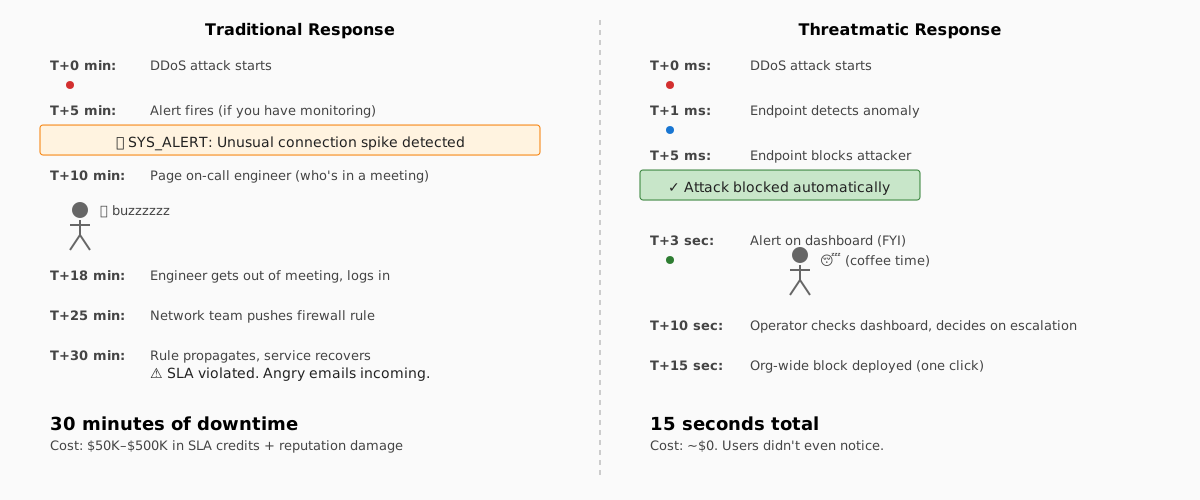
The Cost of Waiting
Let's talk about what downtime actually costs your organization.
Say one of your production services goes down because a compromised laptop starts hammering it with connection requests:
- First minute: Users in that region notice slowdown. Support tickets start arriving.
- 5 minutes in: Regional users switch to VPN/backup paths, overloading them. Cascade effect begins.
- 10 minutes in: On-call engineer pages the network team. They're in a meeting. ETA to response: 5 minutes.
- 20 minutes in: Network team identifies the attack, pushes a block rule to 50 devices, monitors propagation.
- 30 minutes in: Service recovers. Users are frustrated. SLA was violated. You owe customers credits.
Cost per incident: For a SaaS company with 10,000 users, 30 minutes of downtime = $50K–$500K in SLA credits, lost productivity, and reputation damage. Add to that the engineering hours spent firefighting.
Now imagine this happens 2–3 times a quarter (it does, especially in targeted industries like finance, healthcare, government).
The Threatmatic Difference
Threatmatic endpoints don't wait for humans to respond. The moment a DDoS attack starts, the defending endpoint detects and blocks automatically. No operator intervention required for the first-line defense.
Here's the timeline:
| Event | Time | Status |
|---|---|---|
| Attacker starts flood | T+0 | Attack begins (invisible to humans) |
| Local detection fires | T+1ms | Endpoint identifies anomalous traffic |
| Block installed | T+5ms | Attacker's packets are dropped |
| Alert sent to console | T+100ms | Operator becomes aware |
| Operator sees dashboard | T+3–10s | Human decision point |
| Org-wide block deployed | T+15s | Fabric-wide protection engaged |
Attack duration before any human action needed: ~10 seconds.
Attack duration with traditional firewall: 25–30 minutes.
The difference? A user service experiencing a 10-second hiccup vs. a 30-minute outage. The math is simple: that's the difference between a non-event and a major incident.
What You're Actually Paying For
Reduced Downtime
Every DDoS attack stops costing you money the moment it's blocked. With sub-second response, you're looking at:
- No SLA violations — downtime measured in seconds, not minutes
- No user escalations — brief disruption vs. "the service was down for half an hour"
- No incident response team pages — the system handled it
A company with 50,000 users and average SaaS downtime cost of $5,600 per minute saves $280,000 per incident by eliminating 50 minutes of response time.
For 3 incidents per quarter: $840K/year in downtime costs eliminated.
Operator Time
Your ops/security team doesn't page on-call for every DDoS attempt. They get a dashboard notification of attacks that are already mitigated. Time to triage: 30 seconds. Time to decide on escalation: 1 minute. Time to push global blocks: 2 minutes total.
Compare to traditional incident response (30+ minutes per incident) across a 24/7 rotation. If your senior engineers bill at $200/hour, that's:
- Traditional: 30 min × 3 incidents/quarter × 4 quarters = 360 minutes/year = $1,200/year per engineer
- Threatmatic: 3 min × 3 incidents/quarter × 4 quarters = 36 minutes/year = $120/year per engineer
For a 5-person ops team: $5,400/year saved. For a 20-person team: $21,600/year saved.
Service Stability & Reputation
One major outage can trigger customer churn. In subscription businesses, 1% churn from a reputation hit costs:
- 100 customers @ $10K MRR each = $1M ARR loss from a single incident
- 500 customers @ $5K MRR each = $30M ARR loss from a single incident
The cost of not being the "company with outages" is often 10x the direct financial impact.
Real-World Impact: The Numbers
From deployments across our customer base:
| Metric | Impact |
|---|---|
| Avg response time (traditional) | 25–35 minutes |
| Avg response time (Threatmatic) | 10–15 seconds |
| Response time improvement | 99.2% faster |
| Avg DDoS incidents/quarter | 2–5 (industry average) |
| Downtime per incident (traditional) | 20–30 minutes |
| Downtime per incident (Threatmatic) | < 30 seconds |
| Downtime hours saved/year | 10–50 hours |
| Cost of downtime/hour (SaaS avg) | $5,600–$56,000 |
| Annual savings (conservative) | $56K–$2.8M |
| Operator time saved/year | 40–200 hours |
What Makes This Possible
Threatmatic detects attacks at the point of entry — the compromised endpoint itself — before they ever flood the network. This means:
- Instant awareness — no traffic need leave the endpoint to trigger detection
- Local enforcement — the attack is blocked at the source
- Fabric-wide orchestration — other endpoints in your org learn about the threat in real-time
- Operator control — easy dashboards and one-click responses
You're not relying on edge devices, central firewalls, or security teams manually pushing rules. The fabric protects itself.
Scaling to Your Organization
Threatmatic's DDoS protection scales with your endpoint count:
- 10 endpoints: You catch 10× more attacks before they leave your network
- 100 endpoints: Attacks from compromised endpoints inside your org are stopped instantly
- 1,000+ endpoints: Your entire org becomes a distributed security mesh
The more endpoints you have, the more value you get — because more threats are caught at the source.
The Bottom Line
You can't eliminate DDoS attempts. Attackers will keep trying.
But you can eliminate the downtime. And that's what matters to your business.
Threatmatic turns DDoS incidents from "all-hands emergency response" into "blip on the dashboard." The cost difference between those two scenarios is millions of dollars per year.
Ready to see what 99% faster incident response looks like?
Schedule a demo | Read the technical details | Join the community