For decades, the attacker has had the automatic. The defender has been working a bolt-action.
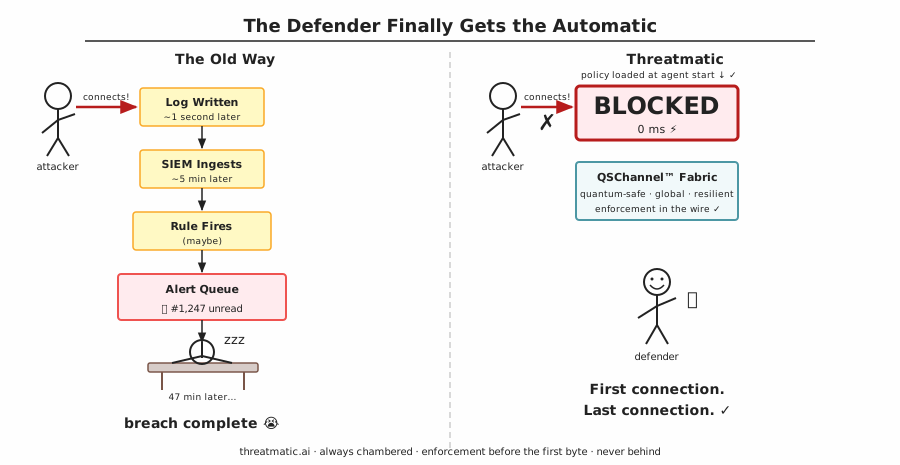
Think about what that means in practice. An attacker deploys a tool, it runs, it connects, it exfiltrates — all in milliseconds, all without hesitation. On the defender's side? A log is written. A SIEM ingests it. A rule fires — maybe. An alert is generated, joins a queue of four hundred others, and waits for a human being to wake up, log in, triage, and decide.
By the time the decision is made, the round has already landed.
This is not a staffing problem. It is not a tooling problem. It is an architecture problem. Security was built around the assumption that humans would be in the loop — reviewing, approving, responding. That assumption made sense when threats moved at human speed. They haven't for a long time.
The Automatic Changed Warfare. Zero Trust Changes Security.
When the automatic weapon arrived, it didn't just make soldiers faster. It changed the entire calculus of engagement. The side with the automatic didn't need to be smarter or stronger. They just needed to be ready — mechanically, continuously, without deliberation.
Zero trust is that shift for cyber. Not because it's a clever product category. But because it relocates the decision point. Instead of asking "did something bad happen?" after the fact, it asks "is this connection authorized?" before the first byte moves. The enforcement is in the fabric, not in the review queue.
Threatmatic Is the Automatic.
The moment a device comes online, policy is live. The moment an application makes its first network connection — known or unknown, trusted or suspicious — it is seen, catalogued, and measured against what is permitted. There is no gap between "connected" and "enforced." There is no window where the attacker can move freely while the defender catches up.
This is what the state of the art actually looks like: not better alerts, not faster analysts, not smarter dashboards. It looks like enforcement that doesn't wait. A fabric that is always chambered. A platform where the answer to "what happens when a threat connects?" is already decided — before the threat connects.
The Attacker Still Has Speed. Now So Does the Defender.
Legacy security tools will keep shipping better detection. Better correlation. Better visualizations of the breach that already happened. That is the bolt-action mindset — refined, accurate, and fundamentally one beat behind.
Threatmatic is built on a different premise: that the defender should never be behind. That policy should be instant, global, and quantum-safe. That the first connection a threat makes should also be its last.
The automatic changed the battlefield.
It's time the defender had one.