Ask any hospital's physical security team what happens after something goes wrong, and the honest answer isn't "we look at the dashboard." It's "someone scrubs through four hours of footage from three cameras, cross-references a badge log they had to export to a spreadsheet, and hopes the elevator system kept its own logs somewhere." The alert did its job. What comes after the alert is still 2004.
That's the part nobody's actually fixed. Detecting the one moment that matters is only half the problem — the other half is everything that happens after, when a question comes in that nobody thought to build a dashboard for. "Was anyone near the pharmacy between midnight and 2am last Tuesday?" isn't an alert. It's a question a person asks three days later, and today the honest answer is: give us a few hours to go find out.
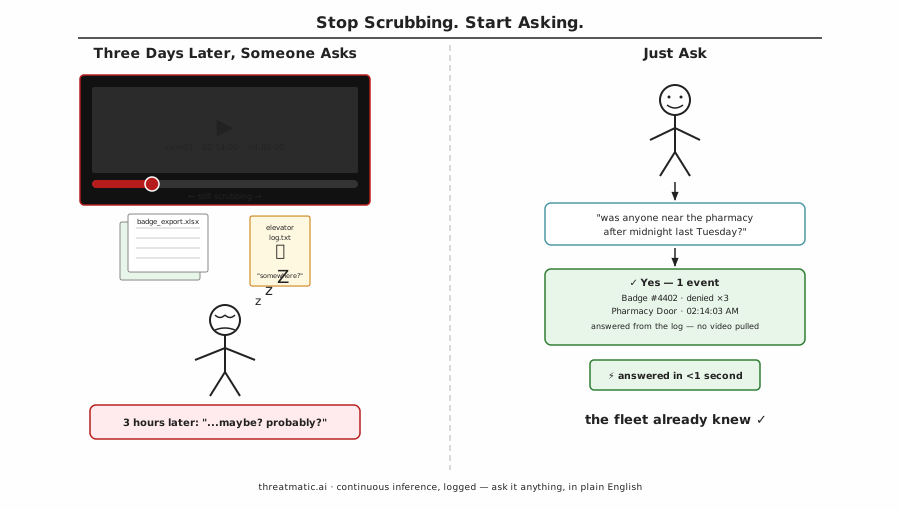
What if the fleet just... told you?
We've already shown, piece by piece, that a camera's traffic shape tells you when a room stops being empty, that a badge reader's failure pattern tells you when someone's testing a lock, that a chiller's cycling tells you when something mechanical is wrong — all without ever touching the actual video, the actual door hardware, or the actual refrigerant loop. Every one of those is already a translation: raw signal in, one clean sentence out. Motion, 117x baseline, Room 214, 2:32pm. Denied, Pharmacy Door, badge #4402, 2:14am. Chiller 2, short-cycling, fourteen times this hour.
The piece we haven't built yet is what happens to that sentence after it's spoken. Right now, it flashes on a dashboard and — if nobody's looking at that exact moment — it's gone. The video that generated it might still exist somewhere, in cold storage, for thirty days, for someone to eventually scrub through if they know to look. But the inference — the one clean sentence that already answered the only question worth asking — doesn't have to disappear. It can be logged, indexed, kept, the same way any other event worth remembering is kept.
Do that continuously, for every camera, every badge reader, every elevator, across an entire campus, and something changes that's bigger than "better alerting." The three-days-later question stops requiring a video review at all. It requires a query.
In plain English, not SQL
Here's the part that actually changes who gets to ask. A log full of clean, structured inferences is queryable the normal way — dashboards, SQL, a BI tool if that's your thing. But once every event is already reduced to a sentence a human would say out loud, there's no reason the question has to be anything less human. "Was anyone near the pharmacy after midnight" isn't a WHERE clause with three joins. It's a sentence. It should get to stay one.
That's the actual unlock: a director doesn't need to know the schema. They don't need to remember which system logs badge events and which one logs motion and which one logs elevator rides. They ask the fleet a question the way they'd ask a colleague who happened to be standing watch the whole time — because, in a sense, that's exactly what's been happening. Every device on the network has been narrating itself, continuously, in plain sentences, since the moment it went live. The only thing missing was a way to ask it something back.
What review looks like when it isn't a chore
None of this replaces the footage. If something genuinely needs to be seen, it's still there. What it replaces is the default — the assumption that finding out what happened means starting with hours of raw material and working backward. Instead, the default becomes: ask the question first. Ninety-nine times out of a hundred, the answer's already sitting in the log, in plain English, because the fleet already said it out loud the moment it happened. The footage is the appendix now, not the whole book.
That's the actual promise underneath "signal in the noise," carried one step further: it was never just about flagging the one thing that matters right now. It's about making every question askable later, too — without ever asking a human to go looking for the needle themselves.