It started with a red screen.
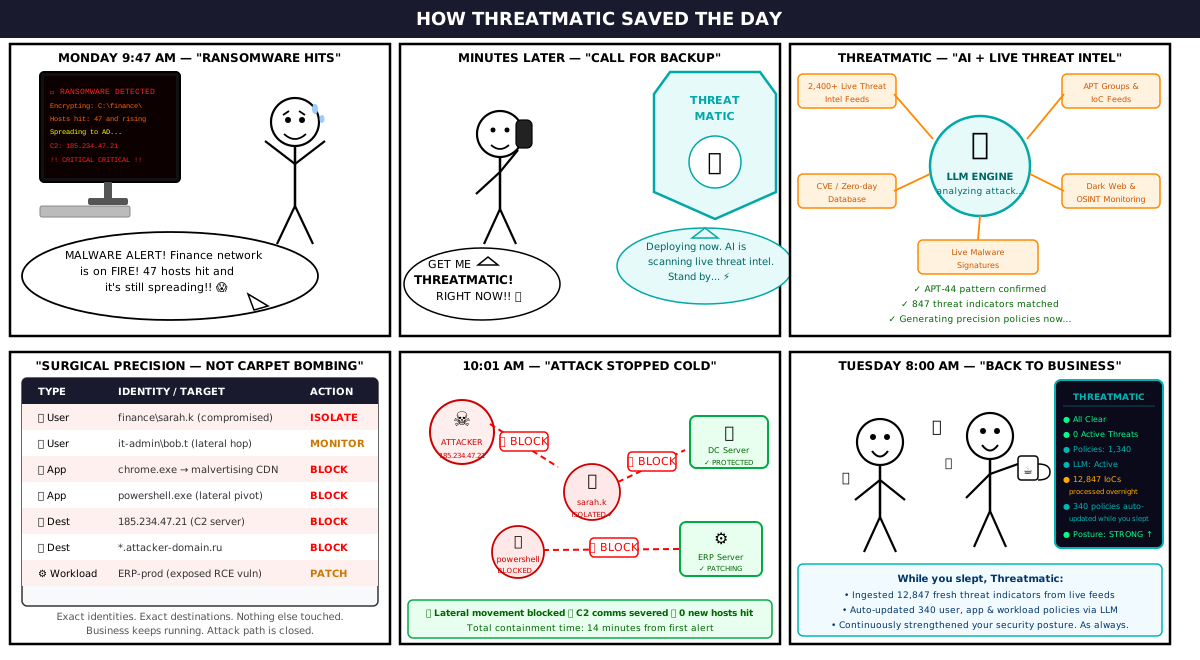
At 9:47 on a Monday morning, the security team's console lit up: ransomware spreading through the finance network, forty-seven hosts already hit, lateral movement detected, a command-and-control server actively calling home.
This is the story of what happened next.
The Problem With Traditional Response
When most security teams detect an active ransomware campaign, the response options are grim:
Option A: Block everything. Shut down segments, kill network paths, isolate broad swaths of infrastructure. Effective — and devastating to the business that just lost access to half its systems during a Monday morning rush.
Option B: Try to trace it manually. Hunt through logs, correlate indicators, write firewall rules by hand. By the time you've assembled a complete picture, the malware has moved three more hops.
Neither option is acceptable. Businesses need security that is fast and precise.
What Threat Intelligence Actually Means
Threatmatic continuously ingests from over 2,400 live threat intelligence feeds — APT group indicators, CVE databases, dark web monitoring, live malware signatures, OSINT streams. This is not a static list updated quarterly. It is a live picture of the global threat landscape, updated constantly.
When the ransomware hit, Threatmatic's LLM engine didn't start from scratch. It cross-referenced the attack pattern against known threat actor playbooks, matched the command-and-control IP against live IoC feeds, and identified the attack signature in seconds.
847 threat indicators matched. APT-44 pattern confirmed. C2 server identified.
Not a hypothesis. A confirmed attribution.
Precision Policies, Not Carpet Bombing
Here is what Threatmatic deployed — and critically, what it didn't deploy:
| Type | Identity / Target | Action |
|---|---|---|
| 👤 User | finance\sarah.k (compromised) | ISOLATE |
| 👤 User | it-admin\bob.t (lateral hop) | MONITOR |
| 📱 App | chrome.exe → malvertising CDN | BLOCK |
| 📱 App | powershell.exe (lateral pivot) | BLOCK |
| 🌐 Destination | 185.234.47.21 (C2 server) | BLOCK |
| 🌐 Destination | *.attacker-domain.ru | BLOCK |
| ⚙️ Workload | ERP-prod (exposed RCE vulnerability) | PATCH |
Every other user, application, and network path continued operating normally. Colleagues who had nothing to do with the attack never noticed anything happened. The finance team was isolated and protected while investigation proceeded. The attacker's infrastructure was severed at the network layer before a single ransom note appeared on a screen.
This is the difference between identity-aware policy enforcement and network-layer blunt force.
The Attack Path That Never Completed
The attacker's playbook was textbook APT-44: compromise a finance workstation through a malvertised browser download, use the compromised user session to pivot laterally via PowerShell to the domain controller, reach the ERP server through a known RCE vulnerability, and deploy the ransomware payload from there.
Threatmatic blocked every step:
- The compromised user session was isolated before the lateral pivot could execute
- PowerShell's connection attempt to the domain controller was blocked at the identity layer
- The C2 beacon from the ERP server was cut before exfiltration began
- The RCE vulnerability on ERP-prod was flagged for immediate patching
Zero additional hosts were infected. Total containment: fourteen minutes.
Continuous Posture Improvement — While You Sleep
The incident was contained by noon. But Threatmatic didn't clock out.
That night, while the team was home:
- 12,847 fresh threat indicators were ingested from live feeds and processed by the LLM engine
- 340 user, application, and workload policies were automatically updated to reflect the latest threat intelligence — without anyone writing a rule
- The security posture score moved up, not down, because the incident response data was used to strengthen the model
This is what "continuously assess and strengthen your security posture" actually means in practice. Not a quarterly pen test. Not a manual policy review. A system that reads the threat landscape every hour and asks: given what we know right now, are our policies still right?
Identity Is the Control Plane
The lesson from Monday morning is not "have good incident response." It is: when your security is built on cryptographic identity — for users, for applications, for workloads, for network destinations — you can act with precision instead of panic.
Threatmatic knows who every user is. It knows what every application is authorized to do. It knows which network destinations each workload is permitted to reach. When something falls outside those explicit permissions, it doesn't wait for a human to notice — it acts.
The business kept running. The attack was stopped. The team had their coffee.
Ready to see what precision looks like in your environment? Start a 14-day Silent Discovery Pilot — no agents, no disruption, no changes to your infrastructure.