The VPN had a good run. For the better part of three decades, it was the workhorse of remote access — a reliable way to extend the corporate perimeter to employees working from home, traveling, or connecting from branch offices.
The problem is that the corporate perimeter it was designed to extend no longer exists.
Built for a World That's Gone
The VPN model rests on a simple assumption: there is an inside and an outside. Your data lives inside the perimeter — on servers in your data center, on workstations in your offices. Trusted users connect from outside and, through the VPN tunnel, are brought inside.
This was a reasonable model when your applications lived on-premises, when your employees worked from known locations, and when the perimeter was something you could actually define and defend.
None of those things are true anymore.
Applications live in SaaS platforms, cloud environments, and hybrid infrastructure scattered across multiple providers. Employees work from home offices, coffee shops, airports, and hotel rooms. Contractors and partners access your systems from entirely unmanaged devices. The "inside" and "outside" that VPNs were built around have dissolved.
What VPNs give users today is access to your entire network — when what they actually need is access to specific applications. That gap between what VPNs grant and what users actually require is where attackers live.
The Single Point of Failure Problem
VPN architecture centralizes access through concentrators — hardware or virtual appliances that terminate tunnels and route traffic. This design creates single points of failure that are, increasingly, single points of catastrophic attack.
VPN concentrators have become one of the most actively targeted components in enterprise infrastructure. They are externally exposed by definition, they run complex software with consistent vulnerability discovery, and a successful exploit against a concentrator yields access to everything behind it.
The list of critical VPN vulnerabilities disclosed in recent years — across Pulse Secure, Fortinet, Citrix, Cisco, and others — represents a consistent pattern: the technology that is supposed to protect your network has become the most reliable way into it.
Zero Trust Network Access: What Comes Next
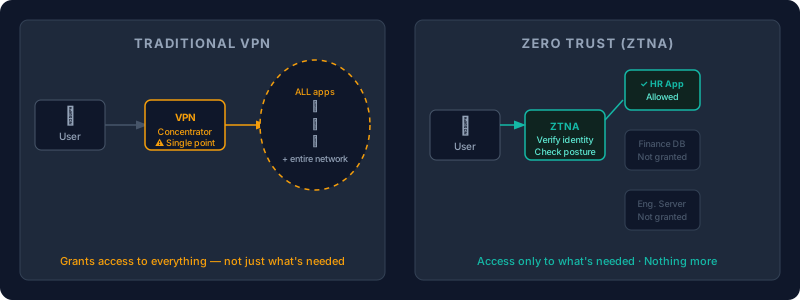
Zero Trust Network Access (ZTNA) replaces the VPN model with a fundamentally different approach: users are never trusted by virtue of network location. Instead, access to specific applications is granted based on verified identity, device posture, and context — and only for the duration of the session.
A user who is authorized to use the HR application can access the HR application. They cannot access the engineering file server, the finance database, or the network segment where your backup infrastructure lives. That access was never granted, because it was never requested.
This is the core principle of Zero Trust: explicit verification for every access decision, with no implicit trust based on network position.
The 14-Day Silent Discovery Pilot
One of the most common concerns about transitioning from VPN to ZTNA is disruption. Organizations worry about blocking legitimate traffic, interrupting workflows, and creating helpdesk chaos during the transition.
Threatmatic addresses this with a 14-Day Silent Discovery Pilot. During this period, agents are deployed across your environment in non-blocking, observation-only mode. Every connection is recorded. Every user's actual access patterns are mapped. Every application dependency is documented.
At the end of 14 days, you have a complete picture of what your users actually do — and a suggested policy whitelist built from real behavior, not guesswork. When you switch to enforcement mode, you're enforcing policies built on observed reality, not assumptions.
The transition doesn't create disruption. It reflects how your organization already works — and then protects it.
The VPN Isn't Coming Back
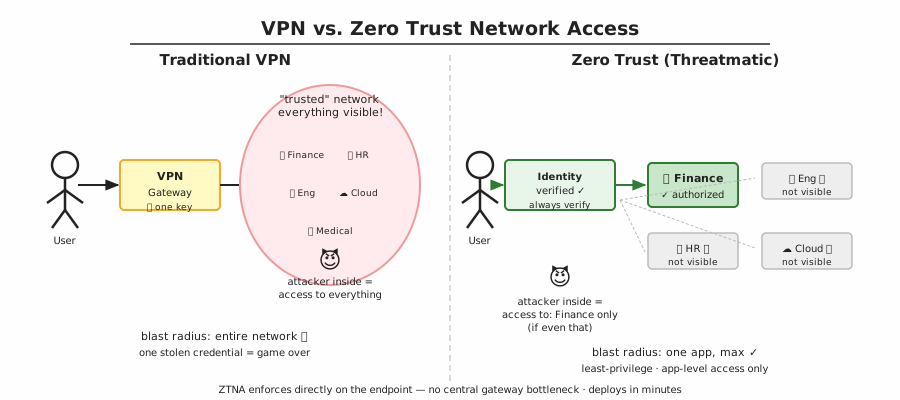
The security industry has a tendency to hold onto familiar tools long after they've outlived their usefulness. VPNs are familiar. They work, after a fashion. And replacing them requires effort.
But the effort of maintaining, patching, and defending VPN infrastructure — infrastructure that grants excessive access, creates concentrated attack surfaces, and was designed for a network topology that no longer exists — is greater than the effort of replacing it.
Your VPN is already dead. The question is how long you're going to keep it on life support.
Start your 14-Day Silent Discovery Pilot. Visit threatmatic.ai