The gate opens at 6:30 PM. Your team is in position. The weapons detector is powered on, the tablet is live, and 8,000 people are about to walk through the door.
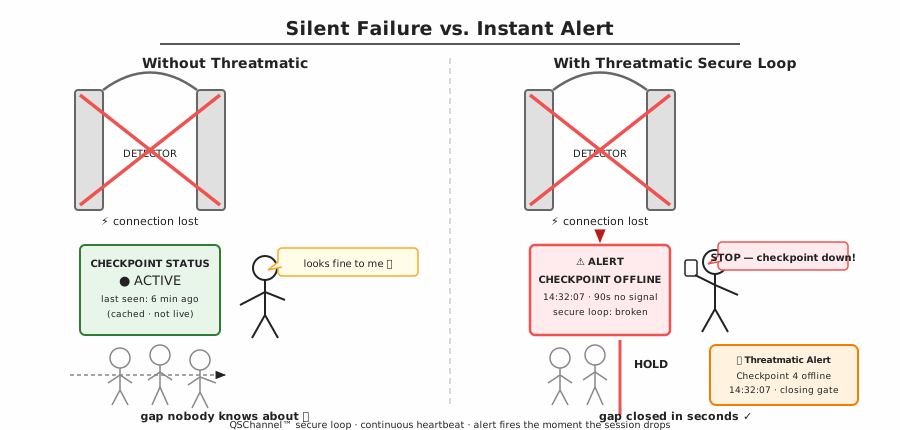
Somewhere between the third act and the headliner, the detector drops off the network. Nobody gets an alert. The tablet still shows a green screen — a cached state from the last successful handshake. Security staff assume everything is fine. The checkpoint keeps running. No one knows the detector is blind.
This is not a hypothetical. It is the default behavior of most weapons detection deployments today.
The Silent Failure Problem
Weapons detectors are life-safety devices. When they work, they're invisible. When they fail, the consequences can be catastrophic — and the failure mode most operators don't plan for isn't a hardware breakdown. It's a connectivity failure that nobody notices.
Most detector-to-tablet communications are built on off-the-shelf networking stacks. The tablet shows status when it receives a packet. When packets stop, the screen often doesn't update — it simply holds the last known state. A detector that powers off, loses its network connection, or is physically moved off-site may continue to show as "active" on the management console for minutes or hours.
For a venue security director running eight checkpoints across a 20,000-seat arena, silent failures are the threat model that keeps you up at night. Not the attacker trying to bypass the detector — the gap in your coverage that nobody told you about.
A Secure Loop That Knows It's Working
Threatmatic deploys a dedicated, air-gapped secure loop between each weapons detector and its paired command tablet using QSChannel™ — an encrypted, zero-trust network access layer that is completely isolated from your venue's general Wi-Fi and IT infrastructure.
This isn't just a connectivity improvement. The secure loop itself becomes the monitoring layer.
Because QSChannel™ maintains a continuous, cryptographically verified connection between the detector and the tablet, any disruption to that connection is immediately detectable — not after a timeout, not on the next polling cycle, but in real time. The moment the detector stops responding to session handshakes, the system knows.
And it tells you.
Smart Status Alerts, Right Where You Need Them
Threatmatic's health monitoring generates alerts on three trigger conditions:
Device offline. If a detector drops off the secure loop — power loss, hardware failure, physical disconnection, or network fault — the command tablet receives an immediate alert and the checkpoint status updates to "unverified." Your operations center gets the same notification simultaneously.
Communication anomaly. If the detector is online but its communication pattern changes — unexpected packet loss, latency spikes, protocol deviations — the system flags the anomaly before it becomes a full failure. You get a warning, not a crisis.
Unauthorized access attempt. QSChannel™ operates on the zero trust principle: nothing is permitted unless it is explicitly verified. If anything attempts to connect to or communicate with the detector outside the defined secure loop — a rogue device on the venue network, an unauthorized query, any unexpected traffic — it is blocked and logged. You see it. The attacker doesn't get a second attempt.
Alerts are delivered to the command tablet, the venue operations dashboard, and — optionally — direct to your team's mobile devices. The format is plain language, not a packet dump: "Checkpoint 4 detector offline — 14:32:07. No traffic received for 90 seconds."
Zero Trust Peace of Mind
The reason the secure loop matters beyond simple monitoring is what it prevents.
Traditional venue networks are flat. A weapons detector connected to venue Wi-Fi is, in practice, connected to everything else on that network — the point-of-sale terminals, the back-office computers, the concession management systems, the guest Wi-Fi that shares the same SSID with a different password. An attacker who compromises one device has a path to everything else.
Threatmatic's air-gapped secure loop changes this entirely. The weapons detector exists in its own cryptographic zone, connected only to its paired tablet through a QSChannel™ micro-tunnel. It cannot be reached from the venue network. It cannot be spoofed by a device claiming to be the management console. Every packet between the detector and the tablet is encrypted and authenticated — session by session, handshake by handshake.
The detector you installed is the detector that's talking to the tablet. Not a clone. Not a spoof. Not an attacker who found an open port. The real thing, continuously verified.
Deployment at Venue Scale
Threatmatic's secure loop deploys without touching your venue's existing network infrastructure. Each detector-tablet pair operates on its own isolated channel. Adding a new checkpoint is a matter of enrolling the device — no VLAN reconfiguration, no firewall rules, no IT project.
The management layer gives your operations team a single view across all checkpoints: which detectors are online, which are degraded, which have triggered anomaly alerts, and a full event log for every checkpoint — timestamped, tamper-evident, and ready for post-event review.
For venues managing multiple events per week, the operational simplicity is as important as the security. Your security director shouldn't need an IT team to know whether Checkpoint 4 is working.
Intelligence That Improves Over Time — Without Exposing Anyone
Every detection event is a data point. The type of weapon. Where on the body it was concealed. The location in the venue. The time of day. Aggregated across events and venues, this information builds a threat intelligence picture that makes future screenings sharper and faster.
The problem, until now, has been privacy. Capturing and retaining incident-level data means retaining information tied to real people — and that creates legal exposure, consent obligations, and a data liability that most venues don't want.
Threatmatic resolves this with two purpose-built capabilities: Privacy Enhancing Technology (PET) and fully homomorphic encryption (FHE).
Privacy Enhancing Technology means Threatmatic's analytics operate without ever touching personally identifiable information. Incident records are stripped of any data that could identify an individual before they enter the analytics pipeline. The system learns from patterns, not people.
Fully homomorphic encryption goes further: computation happens directly on encrypted data, without decrypting it first. Threatmatic can analyse incident attributes — general physical descriptors, weapon type, concealment location, checkpoint position — and surface actionable intelligence across your security operation without the underlying records ever existing in plaintext. The insights are real. The raw data is never exposed.
In practice, this means your security operation can answer questions that matter:
- What concealment locations appear most frequently at high-capacity entry points?
- Which checkpoint configurations produce the most detection events per thousand screenings?
- How do detection patterns shift across event types and audience demographics?
Your team gets the intelligence. No PII is stored, no individual is profiled, and no data liability is created. Threatmatic gives you the pattern without the person.
The Standard You Should Expect
Every checkpoint in your venue is a commitment to the people walking through it. The detector should work. The tablet should reflect what the detector is actually doing. And if anything changes, you should know before the problem becomes a gap.
Threatmatic's air-gapped secure loop and health monitoring hold that commitment at the infrastructure level — not as a manual check, not as an assumption, but as a continuously verified, cryptographically enforced guarantee.
Your detector is live. Your loop is secure. And if anything changes, you'll be the first to know.
To deploy Threatmatic's secure loop at your venue, contact us or start a pilot at your next event.