There are a lot of secure tunneling solutions on the market. Most of them encrypt your traffic. Most of them claim to be fast. Most of them say they're secure.
QSChannel™ does something most of them don't: it's built to remain secure even after quantum computers make today's standard encryption obsolete.
Here's what that means in practice.
The Problem With Standard Tunneling
Every VPN, every TLS connection, every secure tunnel you use today relies on the same foundational assumption: that certain mathematical problems — factoring large numbers, computing discrete logarithms — are hard enough that no computer can solve them in a useful timeframe.
That assumption is correct for classical computers. A classical computer would take millions of years to break a properly implemented 2048-bit RSA key.
A quantum computer running Shor's algorithm could do it in hours.
This isn't a theoretical concern. NIST finalized post-quantum cryptography standards in 2024 precisely because the cryptographic community recognized that the transition needs to happen before quantum computers become capable, not after. Nation-state adversaries are already harvesting encrypted traffic today, banking on the ability to decrypt it once quantum computing matures.
Standard tunneling solutions — WireGuard, IPSec, OpenVPN, most commercial VPN products — acknowledge this vulnerability. Their post-quantum defenses, where they exist at all, are optional configurations, bolt-on additions to architectures that weren't designed with quantum resistance in mind.
Asymmetric Path Isolation
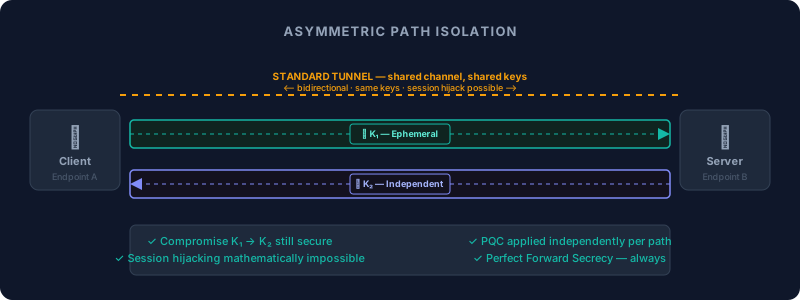
The foundational architectural difference in QSChannel™ is asymmetric path isolation.
In a standard tunnel, outbound and inbound traffic share the same encrypted channel, the same key material, and the same cryptographic assumptions. If the encryption is broken, both directions of the conversation are exposed.
QSChannel™ routes outbound and inbound traffic on separate encrypted tunnels with independent keys. This has two important consequences:
1. Session hijacking becomes mathematically impossible. An attacker who compromises one direction of a session gains no information about the other. There is no session to hijack — only two independent, one-way channels that together form a conversation.
2. Quantum-resistant encryption can be applied independently to each path. QSChannel™ implements ML-KEM (NIST FIPS 203) for key encapsulation on both tunnels, ensuring that traffic captured today cannot be decrypted by quantum methods in the future.
Ephemeral Keys, Always
Every QSChannel™ session generates a fresh key pair. No long-lived keys are ever reused across sessions.
This property — Perfect Forward Secrecy — means that compromising a device yields zero usable cryptographic material from any previous session. An attacker who steals a device today cannot decrypt traffic that device sent last week, last month, or last year.
Perfect Forward Secrecy is considered a best practice in secure communications. In QSChannel™, it is not a configuration option. It is the only mode of operation.
Built on Open Standards
QSChannel™'s quantum-resistant cryptography is built on NIST-standardized algorithms:
- ML-KEM (FIPS 203) — for key encapsulation, replacing ECDH
- ML-DSA (FIPS 204) — for digital signatures, replacing classical DSA
These are not proprietary implementations. They are the algorithms that NIST spent years evaluating and that government agencies are now required to adopt. Building on open standards means QSChannel™ customers are not locked into a proprietary cryptographic approach that may be superseded or found vulnerable — they are running the same algorithms that will underpin global cryptographic infrastructure for the foreseeable future.
The Compliance Reality
For regulated industries, post-quantum cryptography is rapidly moving from best practice to requirement.
CISA, the NSA's Commercial National Security Algorithm Suite 2.0 (CNSA 2.0), and emerging frameworks for healthcare and financial services are all pointing in the same direction: organizations need to be running NIST-compliant PQC algorithms, and the transition window is not indefinite.
Cyber insurers are beginning to factor PQC adoption into underwriting. Organizations that cannot demonstrate quantum-safe encryption are increasingly viewed as carrying unquantified tail risk — with premium implications that will only grow as awareness of the harvest-now-decrypt-later threat increases.
What QSChannel™ Is Not
QSChannel™ is not a VPN with quantum features bolted on. It is not a traditional secure tunnel with an updated key exchange algorithm. It is an asymmetric, dual-path, quantum-native secure connectivity layer built from the ground up around the assumption that classical cryptographic assumptions will eventually fail.
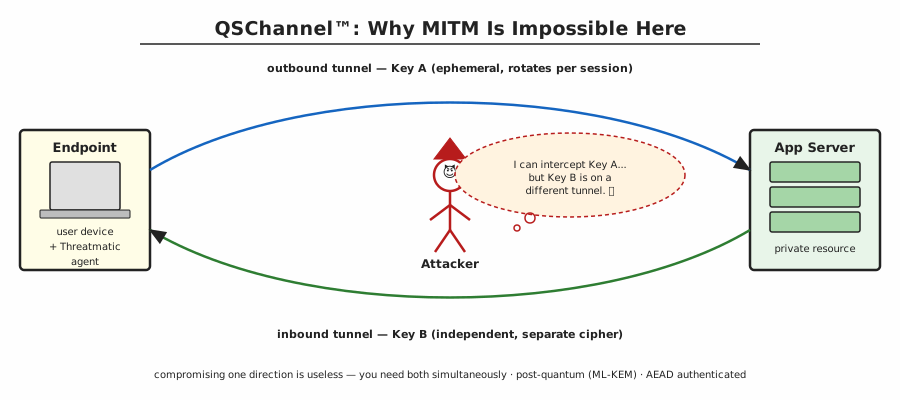
That is what doing it differently looks like.
Explore QSChannel™ and Threatmatic's full Zero Trust platform. Visit threatmatic.ai