Half past three in the morning, and the security office is a wall of light: six hundred camera tiles across four monitors, each one a small rectangle of grainy grey. A supply closet. A loading dock. A hallway outside radiology. Somewhere in that wall is the one tile that matters right now — and there is no human way to find it by looking.
That's the actual job, not the movie version of it. Nobody watches six hundred feeds at once. You watch a badge log, an access alert, a motion trigger from a decade-old sensor bolted over a door — and then you go looking for the one camera that might explain it. By the time you find the right tile, whatever happened has usually already happened.
Here's the part nobody tells you about hospital security: even when the camera exists, and even when it's pointed at exactly the right room, you often aren't supposed to just pull up the live feed and watch. Patient rooms, exam bays, medication storage where staff badge in and out all day — a lot of that video is access-logged and locked down by policy, because watching it live on a hunch is itself a privacy problem. The camera can see. The rules on when a person is allowed to look are much narrower than "whenever you're curious."
So the question a security team quietly lives with isn't "where are our cameras." It's this: how do you know something is happening in a room you're not allowed to be watching?
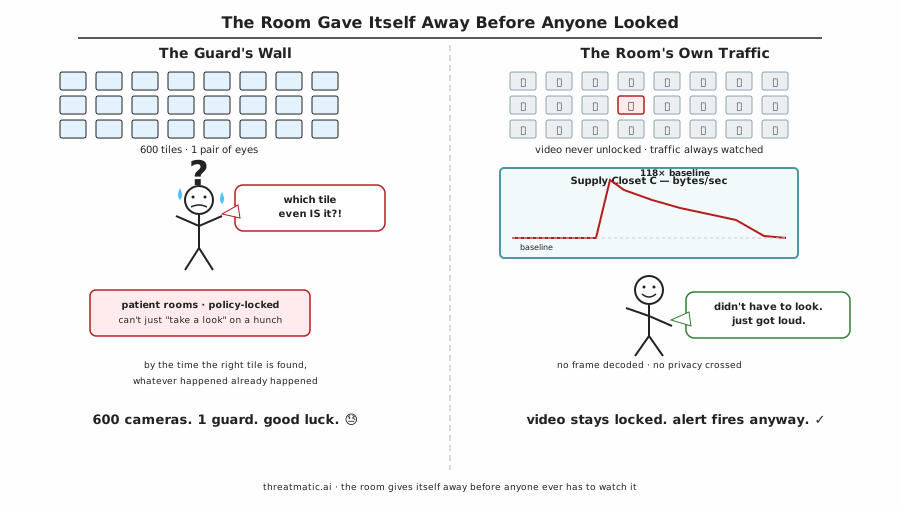
It turns out the video was never the only place the answer lived.
The room's own traffic gives it away
Every camera stream, encrypted or not, has a shape to it — not what it shows, just how much it costs to describe. Modern video compression is lazy in exactly the way you'd want: an empty room, lights off, nothing moving, collapses to almost nothing. Frame after frame is nearly identical to the last one, so the encoder just says "same as before" and moves on. Describing a room where nothing is happening costs almost no data at all.
The instant something moves — a person crossing the frame, a door swinging open, someone reaching into a cabinet — that laziness breaks. The encoder has to spend real bits describing what actually changed, frame by frame, in real time. On the wire, that shows up as a spike: a room that was whispering a few hundred bytes a second suddenly shouting a hundred times that, sometimes more, for as long as something keeps moving.
You don't have to unlock a single frame to see that shape. You don't have to know who it is, or what they're doing, or anything the video itself shows. You just have to be watching the traffic — the size and timing of packets moving between a camera and wherever its feed goes — the same way you'd know someone was pacing in the next room from the sound of footsteps through a wall, without ever opening the door.
That's the alert that actually matters at 3am: not "here's a picture of the closet," but "the closet, which should be silent, just started talking a hundred times louder than it should." The system that fires it never had to look inside. It just noticed the room got loud.
The rest of the hospital talks the same way
The same idea scales past cameras. A hospital floor is full of devices that were never built with security in mind and can't be retrofitted with one — infusion pumps, patient monitors, imaging equipment, ventilators. Most of them run whatever embedded software shipped with them, often years out of patch, because touching that software at all can mean re-certifying the device with a regulator. IT can't install an agent on an infusion pump. Half the time, IT can't even ask it a question.
But every one of these devices still has to talk — to a nurse's station, to a central monitoring system, to the hospital's own network — and that talk has a shape, exactly like the camera's video did. A pump reporting vitals every thirty seconds has a rhythm as regular as a heartbeat. A monitor quietly reflashed with something it shouldn't be running starts talking differently: new destinations, new timing, more bytes than a status update should ever cost. None of that requires touching the device, understanding its firmware, or waiting for a vendor's patch. It only requires already watching what's crossing the wire.
That's the real reframe. You don't secure a medical device by getting inside it — most of the time, you're not allowed to, and you shouldn't need to. You secure it by knowing, cold, what "normal" sounds like from the outside, and noticing the second it stops.
Privacy and security, on the same side for once
That's the part worth sitting with. Hospital security and patient privacy usually pull in opposite directions — more visibility for one side generally means less privacy for the other. A detector that works purely off traffic shape doesn't have to make that trade. It never decodes the stream, never stores a frame, never gives anyone a reason to "just take a quick look." It answers the only question a guard actually needs answered in the moment — is something happening in there right now — and leaves the video exactly as locked as it was supposed to be.
The room gives itself away before anyone ever has to watch it. That's not a surveillance story. It's the opposite of one.