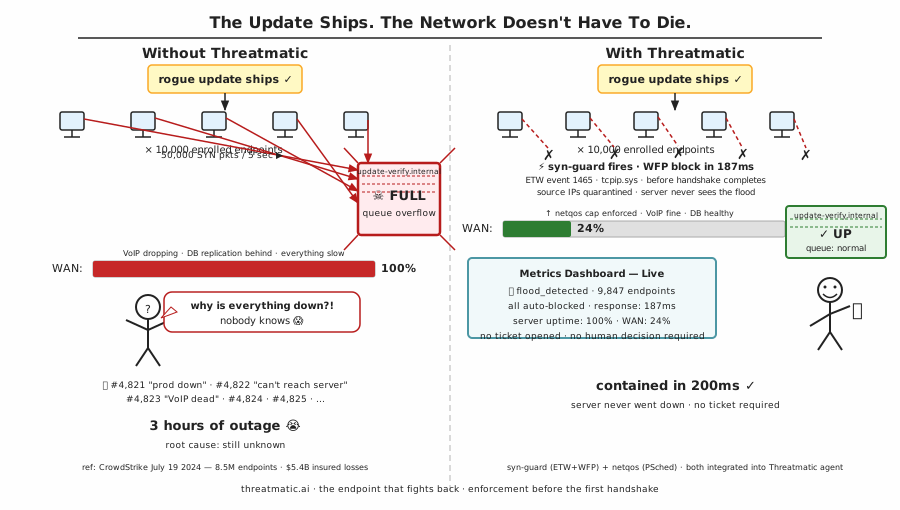
On July 19, 2024, a single content update file — 291 bytes — pushed to 8.5 million Windows endpoints triggered the largest IT outage in recorded history. Airlines grounded. Hospitals postponed surgeries. Banks went dark. The culprit wasn't a hacker. It was a routine update from a security vendor.
In 2012, Knight Capital deployed a rogue trading algorithm to a single server they forgot to update. In 45 minutes, it executed $7 billion in erroneous trades and lost $440 million. The software ran perfectly — it just shouldn't have been running at all.
In 2017, Maersk received a software update through a Ukrainian accounting package called M.E.Doc. The update contained NotPetya. Within hours, Maersk's entire global shipping operation — 45,000 PCs, 4,000 servers, 2,500 applications — was offline. They reinstalled everything from scratch. The bill: $300 million.
Three incidents. Three different causes. One thing in common: the network had no idea what was happening, and no way to respond.
The Part Nobody Talks About
Every post-mortem from events like these focuses on the same things: patch management, change control, rollback procedures, vendor accountability. All valid. All necessary.
But there's a layer that gets skipped: what happens to your network during the chaos.
When a rogue update hits 10,000 endpoints simultaneously, those endpoints don't just crash or misbehave in isolation. They reach out. They try to phone home to update servers that can't respond. They retry — hundreds of times per second. They flood your internal infrastructure with inbound connection attempts that look, from the network's perspective, indistinguishable from a coordinated DDoS attack.
When a software bug triggers an unexpected sync — say, a backup agent that suddenly decides every endpoint needs to upload its entire disk — your WAN link doesn't ask questions. It saturates. VoIP calls drop. Database replication falls behind. The incident that started as a software problem becomes a network problem, and the network problem makes the software problem ten times harder to diagnose and fix.
This is the gap. Not the update itself. The blast radius of the update on the network — and the absence of anything capable of containing it in real time.
What Containment Actually Looks Like
The Threatmatic agent runs on every enrolled Windows endpoint. It sees every network connection — inbound and outbound — before the packet leaves the machine. When anomalous behavior starts, it doesn't wait for a human to notice a dashboard. It acts.
Scenario one: the connection storm.
A software update ships with a bug. On startup, every updated endpoint immediately attempts to reach the update verification server — not once, but in a tight retry loop. The internal server receives 50,000 inbound TCP connection attempts in five seconds from 10,000 source IPs.
From the server's perspective, this is a SYN flood. The kernel's connection queue fills. Legitimate traffic is refused. The server becomes unreachable to everything — not just the rogue endpoints.
The Threatmatic agent, running syn-guard as a subsystem, is watching. It subscribes to the Microsoft-Windows-TCPIP ETW provider — firing directly from tcpip.sys, before the handshake completes, at true SYN level. The moment any source IP crosses the connection rate threshold (configurable: default 200 connections per 5 seconds), the agent installs a WFP block filter for that source. The block is automatic, surgical, and temporary — it expires after a configurable window and is removed cleanly.
The server stays standing. The other 9,990 endpoints that aren't yet affected can still reach it. The blast radius is contained to the endpoints already exhibiting the behavior, not the entire network.
Every detected flood is reported to the Threatmatic control plane as a device_access_event — the ops team sees the pattern across the fleet in the Metrics dashboard in real time. Not in the post-mortem. Now.
Scenario two: the runaway data transfer.
A backup agent gets misconfigured. Or a compromised update quietly enables a sync that wasn't there before. Either way, one or more endpoints start pushing data outbound at full link speed — saturating the WAN connection, degrading everything else on the network.
The Threatmatic agent is aware of policy. When a policy specifies a throttleRate for a flow — by application name, destination CIDR, port, or protocol — the agent writes a QoS policy to the Windows registry via PSched. Pacer.sys enforces it automatically, no kernel driver required. The runaway process is capped. The WAN link breathes again. Everything else on the network recovers.
This isn't a human making a decision. It's policy, enforced in milliseconds, on the endpoint, before the damage spreads.
Self-Inflicted vs. Unexpected — It Doesn't Matter
There's a tendency to treat self-inflicted outages differently from attacks. The CrowdStrike incident was self-inflicted. NotPetya was an attack dressed as an update. Knight Capital was a deployment error. From a network perspective, the distinction is irrelevant.
What matters is this: an endpoint doing something it shouldn't be doing, at a rate the network can't absorb.
The Threatmatic agent doesn't care about intent. It cares about behavior. Is this endpoint making too many connection attempts per second? Is this process consuming more bandwidth than policy allows? The answer to those questions is the same whether the cause is a bug, a misconfiguration, or a piece of malware.
The response is the same too: detect, cap, report, contain.
The Network as a Control Plane
The lessons from CrowdStrike, Knight Capital, and Maersk are usually framed as software lessons — better testing, better deployment controls, better rollback mechanisms. Those lessons are correct.
But there's a network lesson buried in all three: the network should be a control plane, not a passive medium.
When software misbehaves, the network should notice. It should respond. It should contain the damage before the blast radius spreads from one endpoint to a thousand, from a thousand to a WAN link, from a WAN link to an enterprise.
That is what the Threatmatic agent brings to every enrolled Windows endpoint. Not just policy enforcement in normal times — but a immune system that activates when things go wrong. SYN flood protection with automatic WFP blocking. Per-flow bandwidth enforcement with PSched. Both reporting to the same control plane, both responding in milliseconds, both without waiting for a human to file a ticket.
The update will break. The question is whether your network is ready when it does.