Zero Trust is one of the most talked-about concepts in enterprise security. It is also one of the most misunderstood — treated by vendors as a product category, by compliance teams as a checkbox, and by skeptics as marketing language for technologies that have existed for decades under different names.
The cynicism is understandable. But it misses the core insight that makes Zero Trust genuinely important: the threat model that traditional perimeter security was built to address no longer reflects reality.
What the Perimeter Was Built For
Traditional network security rested on a simple and reasonable premise: there is an inside and an outside. You build walls around the inside. You control what crosses the threshold. Everyone inside the walls is trusted; everyone outside is not.
This model worked when your data lived in your data center, your applications ran on servers in your building, and your employees worked from offices connected to your internal network. The perimeter was physical and well-defined. Defending it was complex, but the boundary was real.
That world is gone.
The Dissolving Perimeter
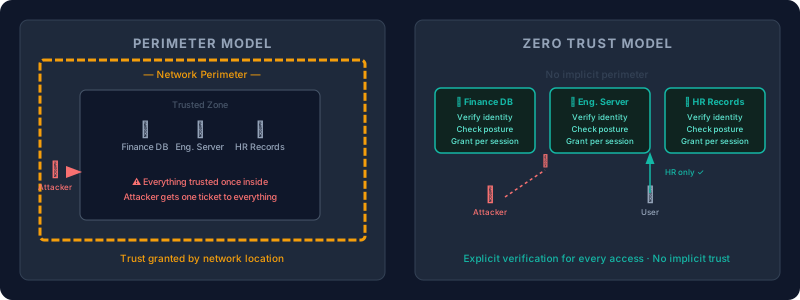
Today, your data lives in AWS, Azure, and a dozen SaaS applications. Your employees work from home offices, coffee shops, and airport lounges. Your contractors access your systems from devices you have never seen and cannot inspect. Your applications span three cloud providers and two on-premises data centers.
Where is the perimeter?
There isn't one. Or more precisely, there are hundreds of micro-perimeters, constantly shifting, impossible to define in the static terms that traditional security tools require. The "inside" now includes any device, anywhere, with valid credentials. The "outside" includes threats that are already inside — residing on compromised endpoints, using stolen credentials, operating through legitimate software.
Perimeter security tries to solve this by extending the perimeter further: SD-WAN, VPN tunnels, cloud-based gateways. Each extension adds complexity and cost. None of them solves the fundamental problem, because the fundamental problem is not that the walls aren't tall enough. It's that walls are the wrong model.
Trust Was Always the Vulnerability
The deeper insight of Zero Trust is not architectural. It's conceptual.
Traditional security implicitly trusted users and devices based on network location. If you were on the internal network, you were trusted. This was never truly safe — insider threats, compromised credentials, and lateral movement all exploit implicit network-location trust. But it was manageable when the network was small, well-defined, and consisted of devices the organization owned and controlled.
In a world where "on the internal network" means "connected through a VPN from an unmanaged personal device from a home office network that also hosts a smart TV, a gaming console, and three other household members' devices" — implicit trust based on network location is not manageable. It's a fiction maintained through inertia.
Zero Trust replaces that fiction with explicit verification: every access request, regardless of its origin, is evaluated on its merits. Identity is verified. Device posture is assessed. Context is considered. Access is granted only to the specific resource being requested, only for the duration of the session, only if the request is consistent with established policy.
No implicit trust. No inherited permissions from network position. No assumption that yesterday's legitimate access makes today's access request legitimate.
What This Means Operationally
Zero Trust is not a product you buy. It is a set of principles that, implemented consistently, produces a security posture that is more resilient, more precise, and more aligned with how modern organizations actually work.
In practice, Zero Trust means:
Identity is the new perimeter. Every access request starts with verified identity — not just a username and password, but continuous authentication and behavioral analysis throughout the session.
Access is least-privilege by default. Users get access to the applications they need. Not to the network segment those applications are in. Not to adjacent systems. Exactly the applications they need.
Devices are evaluated, not assumed. A device's security posture — patch level, EDR status, certificate validity — is assessed before access is granted and monitored continuously throughout the session.
Lateral movement is structurally prevented. Microsegmentation ensures that a compromised device cannot reach systems it has no policy-based reason to access. The blast radius of any breach is contained by design.
Why Now
These principles are not new. The implementation has become viable.
The enforcement capabilities that Zero Trust requires — continuous identity verification, device posture assessment, granular application access, network microsegmentation — used to require enormous infrastructure investment and manual configuration effort. They were achievable only by large organizations with dedicated security engineering teams.
Threatmatic makes them available to organizations of any size, as a unified platform that deploys without hardware, enforces policy without manual firewall rule management, and begins delivering value from day one.
The perimeter is gone. Zero Trust is how you build security without it.
Start your Zero Trust journey with Threatmatic's 14-Day Silent Discovery Pilot. Visit threatmatic.ai