There is a category of device that every security-conscious organisation trusts implicitly. It controls who gets through the door. It reads your biometric. It decides whether the turnstile opens. It records who entered and when.
These devices are the physical security estate — the weapon detectors, biometric access panels, keycard readers, entryway cameras, turnstiles, and door controllers that secure government facilities, data centres, defence installations, courthouses, financial trading floors, and any environment where physical access is considered the last line of defence.
And in almost every deployment, they share a common vulnerability: once enrolled, they are trusted absolutely. Nobody asks the weapon detector to prove it is still the weapon detector.
The Paradox at the Perimeter
Physical security infrastructure is designed to verify everyone else. The irony is that these devices are rarely subjected to the same scrutiny they impose on people.
Consider the typical deployment. A biometric access panel is installed at the entry to a secure server room. It is placed on a dedicated physical security VLAN, isolated from the corporate network. The assumption is that VLAN membership is proof of legitimacy — if a device is on the physical security segment, it belongs there.
That assumption has not aged well.
Modern physical security devices are IP-connected, firmware-driven computers. A keycard reader runs an operating system. A networked camera streams compressed video over TCP/IP. A weapon detection system reports alerts to a central management platform via a documented API. Each of these is a node on the network with the same fundamental attack surface as any other — open ports, exploitable firmware, and the ability to communicate with other systems once compromised.
The VLAN is not a Zero Trust boundary. It is a starting point for an attacker who gets inside it.
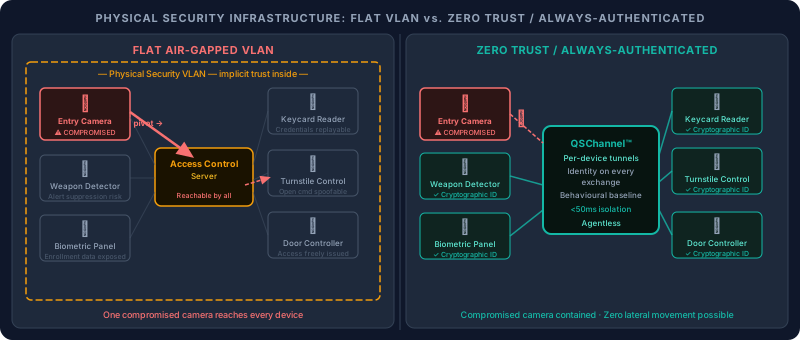
What the Attack Surface Actually Looks Like
Each device category in a physical security estate carries specific risks that are rarely modelled in threat assessments.
Weapon and metal detectors report alert states to a central console. A compromised detector can be made to suppress alerts — not by physically tampering with the hardware, but by intercepting or spoofing the network communication between the device and its management system. An attacker who can inject a "no threat detected" state into that communication channel has effectively blinded the checkpoint without touching the hardware.
Biometric access panels maintain local or networked enrollments of authorised personnel. A device that can be reached by an attacker on the same VLAN can potentially receive forged enrollment commands — adding an unauthorised biometric template without any physical access to the panel itself. The template appears legitimate. The access appears authorised. The audit log shows nothing unusual.
Keycard readers in most deployments communicate with a central access control server to validate credentials. If that communication channel is unencrypted or authenticated only at connection establishment, an attacker who has compromised any other device on the physical security segment can intercept, replay, or spoof access decisions. A cloned credential that has never physically passed through the reader may still be granted access.
Entryway cameras are among the most frequently compromised devices in any network because they are among the most frequently neglected. Unpatched firmware, default credentials, and minimal monitoring make them reliable footholds. A compromised camera doesn't just leak footage — it provides a persistent, authenticated presence on the physical security network from which an attacker can map the environment, intercept management traffic, and pivot toward access control systems.
Turnstiles and door controllers receive open/close commands from the access control server. In a flat physical security network, anything that can reach the access control server can potentially issue those commands. A compromised camera can become a door controller. A spoofed keycard reader can grant unlimited access. The physical and logical become indistinguishable.
Why Air Gapping Is Not Enough
The instinct to air-gap physical security infrastructure is correct in principle. Isolate the network segment. Limit external connectivity. Reduce the attack surface.
The problem is that air gapping addresses perimeter threats, not internal ones. Once an attacker is inside the air-gapped segment — through a compromised device, a supply chain implant, or a rogue USB insertion — the isolation that was supposed to protect the environment now works against the defenders. There is no connectivity to pull threat intelligence. No external monitoring to detect anomalous behaviour. No rapid response capability.
And air-gapped physical security networks are not impenetrable. Devices are provisioned, updated, and maintained. Technicians connect laptops. Vendors access systems remotely for diagnostics. Firmware updates are applied. Each of these activities is a potential vector for introducing a compromised element into the isolated segment.
An attacker who has successfully entered the segment — however they did it — faces a completely unguarded interior. Every device trusts every other device. Lateral movement is unrestricted. The air gap that was supposed to provide security instead provides cover.
Zero Trust / Always-Authenticated: The Framework
Zero Trust / Always-Authenticated (ZT/AA) applies the same principle to physical security devices that it applies to users: trust is never assumed, always verified, and continuously maintained.
The critical distinction between Zero Trust and traditional network segmentation is the word always. A device is not authenticated at enrollment and then trusted implicitly for its operational lifetime. Authentication is continuous. Every communication is verified against a known device identity and a behavioural baseline. A device that begins behaving in ways inconsistent with its known profile — regardless of its location on the network — is flagged and isolated before the anomaly can propagate.
For physical security infrastructure, this has specific and concrete implications.
Device identity is cryptographic, not positional. A weapon detector is not trusted because it is on the physical security VLAN. It is trusted because it holds a verified cryptographic identity and its communications are authenticated with every exchange. A device that has been compromised and is now issuing spoofed communications fails cryptographic verification even if it is still physically in the same rack.
Communication paths are explicitly permitted, nothing else. A biometric panel is authorised to communicate with the biometric enrollment server — and nothing else. Not the camera management system. Not the access control server. Not any other device on the segment. Any attempt to communicate outside its defined policy is blocked automatically and triggers an alert. An attacker who compromises the biometric panel cannot use it as a pivot point to reach anything else.
Encryption is applied at every hop, including within the air-gapped segment. QSChannel™ creates direct, quantum-safe encrypted tunnels between verified device identities. Traffic between a keycard reader and the access control server is encrypted end-to-end, not just at the network perimeter. Interception, replay, and man-in-the-middle attacks — the primary mechanisms for spoofing access decisions — require breaking per-session cryptography that is independent for every exchange.
Anomaly detection is behavioural and continuous. Every device in the estate has a known communication pattern. A camera that streams video to the management server at regular intervals and does nothing else has a predictable baseline. If that camera begins probing other devices on the segment, attempting to reach the access control server, or sending unusual volumes of traffic at unusual times, Threatmatic detects the deviation in real time — not in a weekly log review.
Isolation is sub-50ms and automatic. When a physical security device exhibits behaviour consistent with compromise, it is isolated from the rest of the network before the anomaly can cascade. A compromised weapon detector cannot send false "clear" states. A compromised camera cannot be used as a pivot. The blast radius is contained to the single device.
Unique to the Market
Most Zero Trust platforms were built for enterprise IT environments — managed laptops, cloud workloads, SaaS applications. Applying them to physical security infrastructure requires capabilities that those platforms were never designed to provide. Threatmatic was built differently, and the differences matter most in the environments where the stakes are highest.
Virtual air gap with quantum-safe monitoring. Threatmatic creates a cryptographic air gap — a logical isolation boundary that is functionally equivalent to physical disconnection — without the operational constraints that physical air gapping imposes. Every device communication occurs inside a QSChannel™ micro-tunnel with post-quantum cryptography. This means the monitoring plane itself is quantum-safe: even the telemetry, heartbeats, and event data flowing from devices to the analytics engine are protected against harvest-now-decrypt-later attacks. Adversaries intercepting monitoring traffic today cannot decrypt it with tomorrow's quantum computers.
Secure call-home for genuinely isolated environments. Physical security devices in high-security facilities need two things that seem contradictory: genuine network isolation and the ability to receive policy updates, firmware intelligence, and threat feed updates. Threatmatic's call-home capability provides a controlled, cryptographically authenticated channel through which devices can receive updates and report status without creating a general-purpose network path. A weapon detector in an air-gapped government facility can receive updated threat signatures without ever being exposed to the open internet — and without any inbound connectivity that an attacker could exploit.
Sophisticated, tamper-evident event logging. Threatmatic's event logging goes beyond audit trails. Every policy decision, permitted communication, blocked attempt, anomaly detection, and isolation event is logged with cryptographic integrity — each log entry is chained to the previous, making retroactive tampering detectable. Logs are structured for direct ingestion by SIEM platforms and include device identity, communication metadata, policy context, and timestamps with nanosecond precision. For high-security environments, this means the evidence required for incident investigation, regulatory reporting, and post-event forensics is always available and always verifiable.
Homomorphic encryption: analytics without exposure. This is the capability most unique to Threatmatic and least understood in the market. Homomorphic encryption allows computation to be performed on encrypted data without decrypting it first. For physical security monitoring, the implication is profound: Threatmatic can analyse behavioural patterns, detect anomalies, and enforce policy on device telemetry — without the monitoring system ever seeing the plaintext of what a biometric panel, weapon detector, or access control server is actually processing. The analytics happen in encrypted space. The results are meaningful. The underlying data is never exposed.
Privacy-enhancing security — no PII exposed or stored. Traditional security monitoring creates a privacy paradox: to secure a system, you must inspect it, and inspection means exposure. Threatmatic inverts this. Device identity in Threatmatic is cryptographic, not biographic. The platform does not need to know whose biometric was enrolled, which employee badged in, or what a camera recorded. It tracks device behaviour — communication patterns, protocol conformance, traffic volumes, timing — without ever touching the personal data that those devices process. No personally identifiable information passes through Threatmatic's monitoring plane. No PII is stored. The security of the physical security estate is achieved without creating a secondary data liability.
This combination — virtual air gap, quantum-safe monitoring, secure call-home, tamper-evident logging, homomorphic analytics, and zero PII exposure — does not exist in any other platform. It was designed specifically for environments where the cost of getting security wrong is measured not in breach notifications, but in physical consequences.
Deployment Without Disruption
The practical challenge with applying Zero Trust to physical security infrastructure is that these devices cannot typically run software agents. A turnstile controller does not support third-party endpoint software. A weapon detector has no accessible operating system layer.
Threatmatic's agent-less enrollment addresses this directly. Device fingerprinting identifies every device on the physical security segment — by manufacturer, device type, firmware version, and communication pattern — without requiring any modification to the device itself. Policy is enforced at the network layer, not the device layer. The weapon detector does not know it is protected. The attacker who tries to reach it discovers that every communication path is cryptographically verified and behaviourally monitored.
Deployment happens in passive discovery mode first — a period during which Threatmatic observes and maps the existing communication patterns without enforcing policy. This builds the accurate baseline that makes policy enforcement precise. When enforcement is activated, false positives are minimal because the policy reflects observed reality, not theoretical assumptions.
The Estate That Needs It Most
High-security physical environments — government buildings, defence facilities, financial institutions, critical national infrastructure, secure research labs — face a specific risk calculus. The consequences of a physical security failure are not measured in data loss. They are measured in lives, national security, and irreversible physical access.
For these environments, the physical security estate is not a secondary consideration. It is the primary one. And yet it is routinely protected with the least sophisticated security architecture in the building — a VLAN, some firmware update policies, and the assumption that physical isolation is equivalent to security.
Zero Trust / Always-Authenticated changes that equation. Every device that guards the door is itself guarded. Every communication is verified. Every anomaly is detected. Every compromise is contained.
The door knows who you are. Now the network knows who the door is.
To learn how Threatmatic applies ZT/AA to physical security infrastructure in your environment, visit threatmatic.ai or start a 14-day Silent Discovery Pilot.